
Today we’d like to introduce you to Shayna Powers.
Hi Shayna, it’s an honor to have you on the platform. Thanks for taking the time to share your story with us – to start, maybe you can share some of your backstory with our readers.
Thanks so much for having me!
Sure, so when I was ten years old, I started playing viola in an orchestra at my elementary school. I wanted to play cello, but my mom didn’t want to carry a big instrument everywhere we went, and I absolutely refused to play violin. I thought violin was too popular, and I wanted something “different”, so my mom and I settled on viola. I was pretty average for the first few years, but when I was in eighth grade, an orchestra teacher, Melanie Thomson, believed in me and helped me advance a lot quite quickly.
The next year, due to a scheduling conflict, I was put into the top, very small orchestra at my high school as a freshman. I felt completely out of place. I was good, but I wasn’t thaaat good. Many of the students were ranking as top players in the state, and they practiced their instruments for three or more hours every single day. I really struggled to keep up, but it did inspire me to work harder, and I was introduced to some really incredible classical music that year.
The following year, I asked a viola teacher if she thought I could “make it” as a musician. She said yes but suggested I reach out to the professors at Rice University to see if they would take me on as a student. She knew they could completely transform my technique within a matter of months. I reached out to a violin professor there who I knew helped violists as well. Many of my teachers had studied with him. He was kind in his response but promptly rejected me. His waiting list filled his studio for the next two years. He did, however, tell me that one of his students, Zachary Carrettin, was back in town and suggested I reach out to him. I did, and it was one of the best decisions I’ve ever made.
Zachary took myself and three other students on as his students, and he taught us weekly private lessons. He was exactly what I needed in a teacher. He was kind. He was generous. Sometimes we would pay for an hour lesson, but he would spend three hours with me, teaching me anything and everything related to music. He taught me viola, but more importantly, he sparked an incredible love and appreciation for music and creativity. He taught me about improvisation, ornamentation, music theory, aural skills, acoustics, music history, and different styles of music. Sometimes, he would walk into our lessons with an instrument I had never heard of and relate it to what I was studying. I will forever be grateful to him. He taught me so much. When I went to his Doctoral Recital, he played a Bach Cello Suite. At the end, there are two movements that are each split into two sections, and you repeat each section. The first time he played those sections, he played what was written. But when he repeated the sections, he would add two extra notes for every note that was written. It sounded like a completely different piece but with a subtle hint of the original piece that I had heard and played hundreds of times. I was mesmerized.
I studied with Zachary for as long as I could, but he eventually moved on to become the Orchestra Director at Sam Houston State University and later moved to Colorado to serve as Music Director of the Boulder Bach Festival.
I was fortunate to have amazing teachers in high school as well; Laurie Arnold, Mamie Morlacci, and Tanner Ledford have forever shaped me. I also studied at Interlochen Center for the Arts, which was an amazing experience. Originally, I ended up at Southern Methodist University for college. They have an amazing music program, but sadly, my father passed away during my first year. At the end of my Freshman Year, I transferred to University of Houston to be back in Houston to spend more time with my mom. I graduated from University of Houston in 2019.
For the past few years, I have been exploring who I am and who I want to be as a musician. I have done a lot of experimenting. My friend Eve tells me that it is a “harmonic expansion of the soul.”
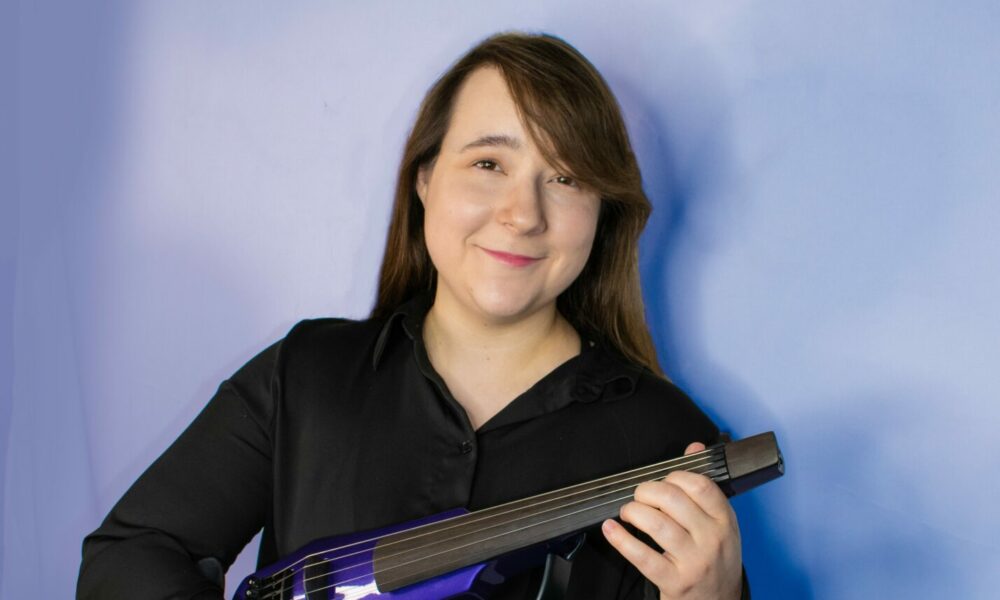
I’ve done some singing, music production, teaching, conducting, lots of live performances on violin and viola, and now I have started performing on electric violin/viola as well. I have been fortunate to perform with two professional symphony orchestras – one as a violist and one as a first violinist. And I am completely obsessed with my new purple, sparkly electric 5-string violin/viola.
Would you say it’s been a smooth road, and if not, what are some of the biggest challenges you’ve faced along the way?
It has been a beautiful journey, but of course, there were some bumps in the road. My father passing away during my freshman year of college is the first thing that comes to mind. He and I had a tumultuous relationship from the time I was about 11 until he passed away when I was 19.
However, he always believed in me. I remember him crying and praising me when he watched my college audition videos. Despite our complicated relationship, I am forever grateful to him, and I’m grateful for all that our relationship taught me and continues to teach me. He sparked a love for music in me at an early age. I have the lyrics “And I knew if I had my chance, that I could make those people dance, and maybe they’d be happy for a while” tattooed on my back. It’s from American Pie by Don McLean, and I have so many memories of my dad and I dancing and scream-singing that song together. Some of my best memories involve music. It seemed to be the one thing that helped us get connect in a good, healthy way even when everything else seemed to fall apart.
I remember during the beginning of my freshman year of college (this might have actually been the last time I saw him now that I think about it), I told my parents I was thinking about changing my major. I said I might want to do something more “practical” than music (please include some form of my current eye roll lol, now I know anything can be made into a lucrative career if you’re entrepreneurial enough. People make $80,000 a year talking about Smurfs, but that’s another topic for a different day).
Anyways, when I told my parents I was going to change my major, my dad immediately shut me down. I remember thinking it was so backwards. I had so many friends who wanted to go into the arts but were pressured by parents and teachers to pursue something more “practical” like medicine or law. And here I was saying, “Mom, Dad, I want to pursue something more practical,” and my dad told me to stay in music instead. I am so grateful I listened. I can’t imagine my life without daily music-making.
I know I am remembering the good times, but there were a lot of extremely painful parts of our relationship as well. He, unfortunately, was directly impacted by the opioid epidemic. And I watched my childhood hero change from the smart, funny man I knew to someone I didn’t recognize and spent years terrified of.
I think something people don’t talk about enough is how painful it is to lose a close relative who you have a less-than-ideal relationship with. I often hear how tragic it is to lose a mom “who was like a best friend,” and so on. And, of course, that is horrible. Absolutely. At the same time, it’s also horrible to lose someone you craved love from who couldn’t or wouldn’t give it to you in the ways that you want and needed. The grief required when you realize you’ll never get that apology you’ve wanted for years, and the grief required when you realize that your relationship will never have a happy ending or happy mending, it can be completely devastating.
And losing a parent, or anyone who has always been in your life, is especially hard because… you’ve never had to live in a world where they don’t exist before. When he died, it felt like I had to create an entirely new reality.
Thanks for sharing that. So, maybe next you can tell us a bit more about your work and what sets you apart?
I play violin and viola mostly, along with a 5-string purple, sparkly electric violin/viola hybrid. I have played in professional symphonies. I often play in small ensembles at weddings, galas, open houses, and more around Houston. I have played in the pit orchestra for ballets and operas. I also teach. I have taught probably close to 500 one-on-one students over the years, and for a little bit of time, I directed a choir of people of Dementia. That was such a beautiful, rewarding experience.
I think I’m probably known for my purple, sparkly electric violin. You don’t see that every day. I hope I’m known for being a fun, kind, down-to-earth person to work with. I’ve been told I have a calming presence in stressful situations and environments. I also teach yoga and meditation, so some people may know me for that.
As for what sets me apart from others, I don’t know. I have things that are unique to me, but we do all, so I guess that just makes us even more of the same. I do think my mindset if often different to other people of my age – the way I approach situations can be different. But I don’t know that I want to be “set apart.” That sounds lonely. Together, depending on each other, lifting each other up, and acknowledging our own individual strengths, that’s where I want to be. I also really love Lisa Nichol’s quote “don’t make me extraordinary because it lets you off the hook”. I don’t ever want people to look at me and I think “I could never do that or have that or be that because x, y, z”. None of that is true. It’s all excuses to not show up and go after what you want. I am not any more extraordinary than anyone else. I’m just a human doing my best and trying to live and create a life I love.
We’d love to hear about how you think about risk-taking.
Sure. Do you want to know my absolute all-time favorite quote? It is by George Bernard Shaw. “The reasonable man adapts himself to the world: the unreasonable one persists in trying to adapt the world to himself. Therefore, all progress depends on the unreasonable man.”
So, I think taking risks is important. Calculated risks, of course; I don’t want anyone to do anything exceedingly dangerous. But I’ve just never understood “playing it safe.” I think we have to sometimes be “unreasonable” and go against conventional wisdom or what other people believe is right for us.
Despite a few moments here and there of “maybe my life would be easier if I did “XYZ,” I really had lived most of my life understanding that nothing is truly “safe” or “secure.” People in industries that we call “stable” lose their jobs all the time. People who take exceptional care of their health are killed in accidents. People who marry a “safe choice” of partner still get divorced. You might as well pursue what truly excites you.
I guess you could say I took a pretty big risk recently. It was a big financial risk for sure because I left multiple jobs to make it happen. I went to Buenos Aires, Argentina for six weeks to volunteer. It was amazing. I loved it.
The biggest thing that led me to go was… I found an old list of goals that I had made years before. I had accomplished some of them, which was great, but there were certain things on that list that I still told myself every day “Tomorrow I will start”. That means two things: one, I was lying to myself EVERY day about the same things (because the tomorrow when I claimed I would start never came). And two, it is highly likely that I am not going to outgrow these goals and dreams. I’m still going to have them down the line if I don’t do them, and I’ll have a lot more regret if I keep waiting. So, I booked the trip less than two weeks out, quit a bunch of jobs, and went. And I’m so thankful I did.
I met a woman while I was there, Sury, who taught me something so important about risk. She was only 19 or 20 years old, but she was so wise. She had just quit her job to pursue music full-time, and we were talking about the concept of job security, comfort zones, how sometimes people hate their job but won’t leave, etc.
We were at lunch, eating vegan sushi. The conversation had been lighthearted leading up to that point. But then she got really serious, turned, looked me in the eyes, and said, “Shayna, your comfort zone isn’t actually comfortable because you know you are meant to be somewhere else.” Maaaaaaaaan. Just let that sink in.
I think if you have goals and dreams that have been with you for a few years or many more, they probably are not going to go away. You must start doing them if you don’t want to regret the alternative later. There’s another beautiful George Bernard Shaw quote about wanting to be “used up” when we pass. I really relate to that. I want to be used up.
I don’t know where these goals and dreams that filled my head exactly came from, but I think they’re worthy of pursuit. And I think that if everyone pursued their own specific goals and dreams, we’d have a better functioning world.
And one more thing, as someone who struggled profoundly with three separate anxiety diagnoses in the past, I will tell you this. Fear absolutely will not go away until you face it. But when you face it, it will be forced to go away with time.
Every time you avoid something you are scared of, your brain goes, “Oh, I suggested that that might be something to fear. Then, the human avoided it. And now we are safe. So logically, we must have been right about the perceived danger. In the future, we will create more fear because we definitely do not want to go towards that thing now that the human has agreed it is dangerous”. And this creates a cycle that leads to more avoidance, that leads to more fear, and so on. The only way to break the cycle is to face the thing you’re scared of, even while your brain screams, “No! Stop! Danger!”
And if you do the thing and wait out that fear by distracting yourself, it will stop.
We are all living with brains that date back to a time when our ancestors were faced with actual life-or-death situations on a daily basis, so now, we get a bill in the mail and think we’re going to die. You are truly safe. Your brain is lying to you. Do the thing you’re scared of, expect to feel terrified in the beginning, immerse yourself fully in the experience. Your brain will learn that there was not a true danger, and the fear will dissolve and it will be replaced with true bliss.
Contact Info:
- Instagram: https://www.instagram.com/
shaynapowersx/ - Facebook: https://www.facebook.com/
shaynakpowers/ - Linkedin: https://www.linkedin.com/in/
shaynapowers/


Image Credits
Daniel Nolan
Through the Shutter Photography