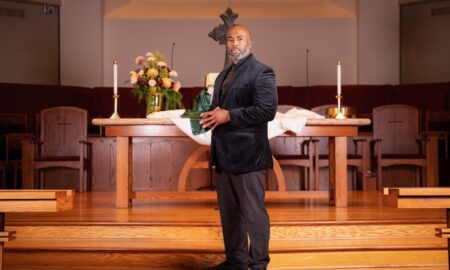




Today we’d like to introduce you to Christopher Troutman.
Christopher, please kick things off for us by telling us about yourself and your journey so far.
I was born in Kansas City, Missouri, lived in Emporia, Kansas, and Stillwater, Oklahoma as a child but spent the most time growing up in Peoria, Illinois. There I attended Bradley University where I earned a BFA in Drawing and Painting. At Bradley, I met my future wife, Rie Fujimaki, originally from Japan, and after graduation, we taught conversational English in Japan for three years. In Kagoshima City, we opened a conversational English school, and I worked on my drawings and paintings for regional, national, and international juried exhibitions where I was able to win some prizes. Rie and I married in 2006 after I was accepted into the MFA program at California State University, Long Beach. We lived there for two years, and I graduated in 2008. After grad school, I taught drawing and painting at Eastern Kentucky University, Vincennes University, and Eastern Illinois University, while there our first son was born. Most recently, since 2013, I have taught all levels of drawing at Lamar University as an Assistant Professor. Now, I have two sons and my family, and I live in Beaumont, Texas, yet we return to Japan every summer.
Can you give our readers some background on your art?
I want to create large-scale drawings on paper based on my personal experiences and depict everyday people and contemporary urban environments, however, I want to maintain the audience’s attention through dynamic compositions and unusual vantage points and thus demonstrate the value of everyday life as a subject in a drawing. The large scale of the drawings collaborates with the extreme vantage points in order to remove the subject matter further from the everyday. One of my goals is that through composition, the resulting artwork will resonate with viewers, and achieve a similar resonance as my visual memories have for me. Additionally, to engage audiences, I enhance narratives and the suggestion of the passage of time by dividing my drawings into multiple sections, referencing graphic novels, the artwork that initially inspired me to make artwork, as well as figurative artists from contemporary art and art history, like Robert Birmelin, Edward Hopper, and Edgar Degas. Lastly, I use polyptychs to splice together scenes from the US and Japan, the two locations I live each year, and attempt to juxtapose similarities and differences between the two.
In terms of process, charcoal is the material that facilitates the fastest method to visually develop ideas and make quick changes, as I typically draw from imagination. However, in terms of imagery, I collect photographs and sketches from observation, from which I do further sketchbook studies in order to put the images to memory. Following that, I often work on compositional studies that synthesize the collected imagery, after which I develop finished drawings. An alternative approach I employ when I do not have an idea ready for a drawing is simply to put random marks on the paper from which I identify and develop representational subject matter. While drawing, I do my best to work from memory and imagination, as I am inspired by the idealized image of comic book artist creating artwork without references, but inevitably memory fails to provide adequate structure and detail. In the end, I return to the original photographs and observational sketches to clarify forms and add final details. Additionally, I use ink and, sometimes, monochromatic mixed media, combining wet and dry materials.
Recently, I have completed a series of oil paintings in color on a canvas where I’ve applied the oil paint with an ink brush using hatching and crosshatching, relying on the line in order to make the painting more like drawing. The subject matter of the series of paintings focused on comparing southern Kyushu with Southeast Texas. Currently, I am working on a series of large drawings that combine digital and traditional drawing materials. The drawings have started on the Mac or iPad using Photoshop or Procreate, respectively, after which they are printed and then drawn over with ink, charcoal, or a combination of materials. My intent is to learn digital media in order to help students in my classes explore new approaches to art-making and further my own practice. In this series, I also compare subject matter from southern Kyushu and Southeast Texas. In the future, I plan to incorporate color into this hybrid digital-traditional drawing series.
Do you think conditions are generally improving for artists? What more can cities and communities do to improve conditions for artists?
It is difficult to make a full-time career as an artist, which is why I teach at Lamar University and have taught for about ten years in total (and I am inspired to teach, as my mother was a university professor at Bradley University, though in accounting!). I think the competition for artists has increased as more people have chosen to study art and the humanities. City grants could help local artists or a service to lead local artists to grants at the county, state, and national levels.
Do you have any events or exhibitions coming up? What’s the best way for someone to check out your work and provide support?
I exhibit primarily in university and college galleries in solo exhibitions and occasionally at nonprofit galleries throughout the US each year. On average, I exhibit in about three solo exhibitions and join about four international juried exhibitions in Japan and three national juried competitions throughout the US. In spring 2019 I will show at the at College of the Mainland Art Gallery, and in summer I’ll exhibit at James May North in Wisconsin, the Miyakonojo City Art Museum in Miyazaki Prefecture, and the Kagoshima City Art Museum in Kagoshima Prefecture, both in Japan. Prints of my work are available through the Ride Gallery in Savannah, Georgia. I can also be contacted through my website is https://
Contact Info:
- Address: 3015 Westmont Dr., Beaumont, TX 77706
- Website: https://
christophertroutman.weebly.com - Phone: 309-472-5137
- Email: [email protected]
- Instagram: https://www.
instagram.com/christopher_ troutman/?hl=en


Image Credit:
Christopher Troutman
Getting in touch: VoyageHouston is built on recommendations from the community; it’s how we uncover hidden gems, so if you know someone who deserves recognition please let us know here.