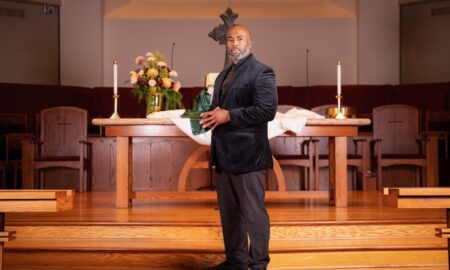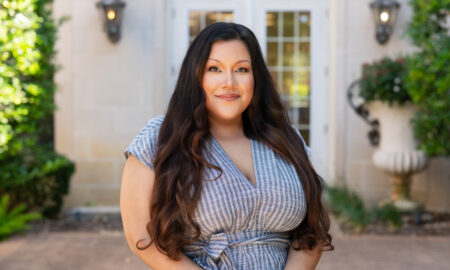



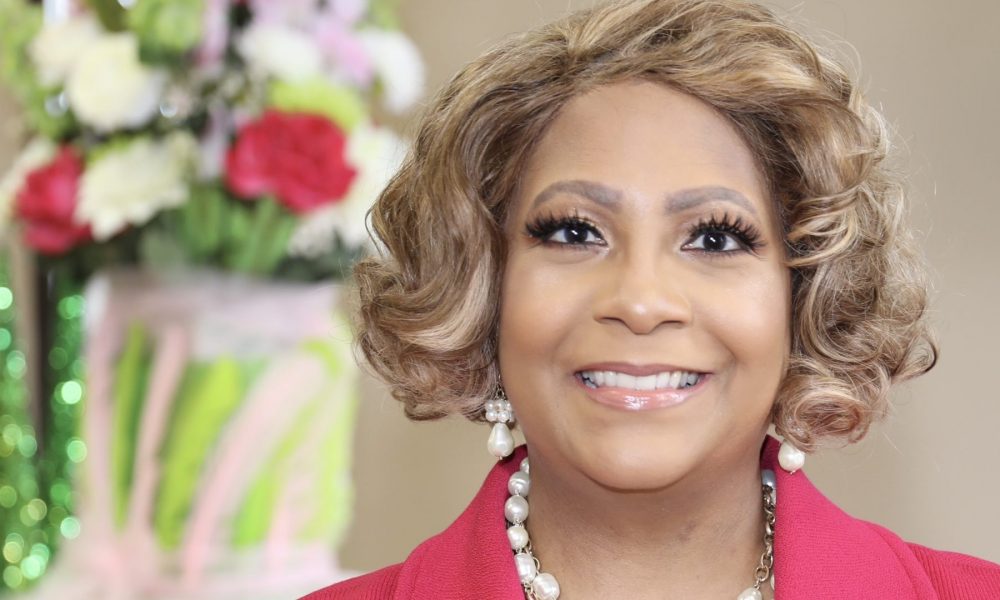
Today we’d like to introduce you to Christina Joy Allen-Crowder.
Christina Joy, can you briefly walk us through your story – how you started and how you got to where you are today.
I’ve been a servant leader and a philanthropist as long as I can remember, but it was only recently that I actually realized that. My current role as Vice-President of Development with Prevent Blindness Texas is really fitting in a number of ways. People often ask me if I planned to have a career in nonprofit management and specifically in development, and my answer is always, “absolutely not!” My background is that I earned a Bachelor of Arts in English and Spanish from The University of Texas at Austin (Hook ‘Em) and I continued my higher education by earning a Doctor of Jurisprudence from The University of Texas School of Law. I was never 100% sure that I wanted to be a lawyer – and was even more convinced of that after my first year of law school – but I really enjoyed the process of learning how to think like a lawyer. I’ve spent my entire career in public service and have been very active in a volunteer and leadership capacity with several nonprofit organizations.
Before I transitioned into full-time nonprofit development work, I was almost always asked to serve on or to lead sponsorship and fundraising committees as a volunteer. I realized that I enjoyed the challenge of meeting or exceeding the stated goals…and I also realized that I was good at it! When I reached the point where I was looking for something more fulfilling as my career, nonprofit development work seemed like the obvious choice. Maybe I should say fundraising as opposed to development since it is a more familiar term, I’ve held development roles with other local nonprofit organizations, but my current role with Prevent Blindness Texas is one that I am especially connected to. I was actually born legally blind but was not diagnosed until I began kindergarten and failed my vision screening miserably. I had learned to read and play piano prior to anyone discovering my vision impairment so it was somewhat baffling. I think my parents may still harbor some residual guilt about not catching that one sooner but the reality is many parents still simply do not know the warning signs that they should look for almost 40 years later. When I miserably failed my vision screening in kindergarten, the school called my mother at home immediately. She made an appointment with a local eye doctor and within days, I was fitted for my first pair of glasses. The lenses were super thick and the frames were not attractive, but they corrected my extreme nearsightedness as much as possible even though my vision was still poor by many standards.
Every year during my childhood, my parents ensured that I had my eyes examined and that I received a new pair of glasses. I was fortunate because my parents had the financial resources to pay for exams and glasses every year, but for so many children in Texans this is not the case. Prevent Blindness Texas is headquartered in Houston, but we serve the entire state of Texas with additional offices in San Antonio and Dallas. I know that the work that I do to generate resources to help Prevent Blindness Texas execute its mission to prevent blindness and preserve sight for adults and children is truly life-changing. I want every child, adult, and senior who fails a vision screening to be able to have their vision impairment addressed so that they can live their best possible life – regardless of income or socioeconomic status. I consider it a huge blessing to be able to combine the work that I do with my personal commitment to serving others at all times while fulfilling my purpose.
Great, so let’s dig a little deeper into the story – has it been an easy path overall and if not, what were the challenges you’ve had to overcome?
I’m always doubtful of anyone who paints a picture that they haven’t encountered challenges along the way in life. Someone once said, “If you want to make God laugh, just make plans for your life.” I think that ‘s true in a lot of ways. My transition from high school to college was not an easy one initially. I graduated from high school ranked number 2 out of 197. I didn’t even realize that was considered a small high school until I started college. So I basically went from living in a town of about 40,000 people to attending a university that had close to 50,000 students at the time. Being at UT was a culture shock in a lot of ways and I spent a lot of time during my first semester there feeling lonely, sad, and isolated. But then something changed, I realized that I was in a place surrounded by opportunities but it would be up to me to choose to make the most of the opportunities or to squander them. I began to look beyond myself and outside of my feelings and started to meet people – and not just ones who looked like me – and get involved on campus through student organizations.
By the time I graduated almost four years later, I was a finalist for Outstanding Student of the Year and was well known as a student leader on campus. Though this was over 20 years ago, I think it’s important to share because I find that many young people have similar experiences. How you respond to being forced to “reinvent yourself” in college in your late teens or early twenties can have a life long impact. Throughout my career, I’ve experienced challenges due to being one of a few women or women of color on the team. I was 28 when I started my first management role and almost everyone on the team of 35 people was older than me. Needless to say, everyone was not receptive to that. Reorganizations and leadership changes can be a struggle if for no reason other than the fear of the unknown. It’s also been a struggle at times to live as a person with an “invisible disability” because I realize how often I am exempted from the discrimination and disenfranchisement that others experience. I have learned over time how to better use my privilege and my platform to help others.
And then there are what I like to call the life things that are bumps in the road. Life happens to us all regardless of our career path or chose work. Things like health issues, economic recessions, deaths of family members and friends, natural disasters, etc. force us all to learn to compartmentalize life in a different way because we still have to focus on the task at hand while striving to maintain and healthy work/life balance.
Please tell us about Prevent Blindness Texas.
Established in 1956 and incorporated in 1965, Prevent Blindness Texas is the state’s leading eye health and safety nonprofit organization dedicated to preventing blindness and preserving sight. We focus on improving the state’s vision and eye health by enhancing community capacity through our core competencies of early detection, patient support, systems enhancement, public policy, public awareness and health education. More than 50% of all blindness can be prevented, yet this can only occur through these essential interventions. While we encourage all individuals to seek regular professional eye care, we recognize that this alone is not enough. Interventions such as vision screenings are an essential element of a strong public health approach to vision and eye health care. Prevent Blindness Texas touches the lives of thousands of Texans through our sight-saving programs and services through our network of volunteers and offices located statewide. The mission of Prevent Blindness Texas is to prevent blindness and preserve sight.
At Prevent Blindness Texas, our vision is vision – making healthy eyes a priority in Texas. We work with our partners across the state so that all children are afforded the benefits of sight as they grow and learn, and that adults are educated about proper eye healthcare and have access to quality eye care. We advocate for the necessary attention and solutions to issues surrounding the aging eye, and that no one endlessly loses their sight due to unsafe practices. We define success when all individuals who need eye care receive it. Our work benefits the community by providing critical eye health information and by working with our partners to provide a continuum of quality vision care to medically under-served Texans, giving them a better quality of life… Prevent Blindness Texas is focused on being an educational leader and resource provider in the eye health/care space across Texas. We are working with and building key partnerships across the state to create and ensure continuums of care exist so that clients are educated from the any point of entry and then adhere to next steps in the continuum to improve vision saving interventions and care. PBT is expanding our presence in targeted communities across the Texas and increasing the number of individuals trained and certified to provide vision screenings, education and navigation.
We are focused on health promotion and eye care prevention. Utilizing data to drive program design is key for our future and improving our mission delivery. Our goal is to increase the number of people accessing and receiving the right care for their vision needs. Our primary programming provides critical vision care to Texas’s most vulnerable citizens via vision screenings, eye health and safety education programs, advocacy, referrals for eye exams and eyeglasses for the uninsured, and many other services targeting those Texas residents most at risk for possible vision problems. We are focused on providing program services that promote eye health and prevent vision loss. We educate, screen, navigate, advocate, and provide resources so that clients can adhere to prescribed eye treatment. Last year, we served more than 36,000 individuals across the state by providing screenings, education, navigation services and resources to improve access to vision care and treatment. We provided 8,000 individuals with necessary follow-up services that they would not have been able to receive without Prevent Blindness Texas.
In partnership with the eye care and health community, we delivered patient education to more than 16,000 adults and certified more than 700 children adult vision screeners through the only national certification program of its kind. We don’t just screen individuals, tell them they failed the screening and leave them to figure out the rest. Instead, we want to help them by providing the necessary resources to address their issues and to close the loop on their need for care. Vision is still not a critical component of the overall health and wellness conversation as it should be. We are most proud of the fact that we know that the work we do changes lives forever. We often hear from individuals who have attended a screening event that we hosted and they share with us that they found out they were diabetic or that they had hypertension as a result of their vision screening. Because they now have increased knowledge about their own health they are better equipped to be able make needed changes in their lifestyle to treat the issue. We literally help to save lives every day.
Is there a characteristic or quality that you feel is essential to success?
My faith and the fact that I see my work as my calling in life helps me to focus on being successful. I am not motivated to be successful for the sake of accolades or acclaim, but I am motivated by meeting the needs of others. There’s a verse in the Bible (Luke 12:48) that reads “To whom much is given, much is required.” I really try to live with that principle in mind, always remembering that my greatest success will be reflected in what I have done for others. When you realize that the work that you do would not exist if there weren’t people who had a need that they otherwise could not meet, it helps you to put and keep things in perspective. Even on the difficult days and during the stressful times – because we all have them – it helps to remember why you do what you do.
It also helps me to remember that I am fulfilling my life’s purpose in my work and not everyone can say that. Perhaps most importantly, I always think that at any given moment, if one thing in my life was different, I could be on the other side of the equation. That’s more than enough to keep me focused on working hard to be successful…and remaining humble! My absolute favorite quote is one by Erma Bombeck that says, “When I stand before God at the end of my life I would hope that I would not have a single bit of talent left, and could say, I used everything you gave me.” That to me is the ultimate success.
Contact Info:
- Address: 2202 Waugh Drive, Houston, Texas 77006
- Website: www.preventblindnesstexas.org
- Phone: 713-526-2559
- Email: callencrowder@pbtexas.org
- Instagram: @preventblindnesstexas
- Facebook: @preventblindnesstexas
- Twitter: @pbtexas
- Other: LinkedIn – @preventblindnesstexas
 Image Credit:
Michael McClennan – photo, Cecily Williams – makeup
Suggest a story: VoyageHouston is built on recommendations from the community; it’s how we uncover hidden gems, so if you or someone you know deserves recognition please let us know here.