
Today we’d like to introduce you to Gil Bruvel.
Hi Gil, thanks for joining us today. We’d love for you to start by introducing yourself.
I was born in Sydney, Australia, and raised in the South of France, where art became part of my life at an early age. I began drawing and painting as a child and had my first exhibition when I was sixteen. My early work was influenced by Surrealism, particularly artists such as Salvador Dalí, Max Ernst, and Giorgio de Chirico, but I was also learning craftsmanship in a very practical way through my father’s cabinetmaking business and later in an art restoration workshop. That combination—imagination supported by technical discipline—has remained central to my work.
I moved to the United States in the 1980s and continued developing my career through painting, sculpture, furniture, and mixed media. Over time, my work evolved away from traditional representation and toward a deeper investigation of perception, consciousness, movement, and the human condition. Meditation became an important part of both my life and my creative process. It taught me to observe thoughts and emotions as constantly changing structures rather than fixed realities, and that perspective began to shape the forms I was creating.
My practice has continued to expand across many materials, including wood, bronze, stainless steel, resin, and works on paper. Series such as Bending the Lines, the Masks, Pixelated Forms, and the Flow Series may appear visually different, but they are connected by the same inquiry: how individual elements can accumulate, bend, fragment, or flow into a larger experience. I am less interested in illustrating an idea than in creating an object that allows the viewer to experience transformation directly.
Today, I work from my studio in Wimberley, in the Texas Hill Country, with a small team that helps me realize projects ranging from intimate sculptures to large-scale public and architectural works. My work has been exhibited and collected internationally, and I continue collaborating with galleries, collectors, designers, architects, and fabricators in the United States, Europe, and Asia.
Even after decades of working as an artist, I do not feel that I have arrived at a final destination. Each body of work raises another question. What continues to motivate me is the possibility of discovering a form I have not yet seen—something that reveals a new relationship between material, movement, perception, and consciousness.
This is already strong enough to submit. The only addition worth considering would be one concrete milestone—such as a significant international exhibition, public project, or major collection—but only if you want the answer to feel more career-focused. I would not turn this into a list of achievements; the story is stronger when it explains the evolution of the work.
I’m sure it wasn’t obstacle-free, but would you say the journey has been fairly smooth so far?
It has not been a smooth road, although I am not sure a serious artistic life is supposed to be smooth. The greatest challenge has been sustaining the freedom to keep evolving while also building a career capable of supporting that evolution.
An artist is often encouraged to repeat what becomes recognizable or commercially successful. That can be tempting, especially when galleries, collectors, employees, and production costs are involved. But repetition can also become a trap. Several times in my career, I have moved away from work that people already understood in order to explore something less certain. Shifting between painting, functional art, mixed media, wood, bronze, and stainless steel has required me to begin again repeatedly—to learn new processes, accept failures, and sometimes risk confusing the market.
There have also been the practical realities of making a living through art. Income is rarely predictable, and opportunities do not always arrive in proportion to the quality or effort behind the work. Galleries and partnerships can be valuable, but artists must learn to protect their work, understand the business surrounding it, and avoid giving away too much control. I had to become not only an artist, but also a problem solver, negotiator, designer, producer, and businessperson.
As the work became more technically ambitious, the challenges changed. Large-scale sculpture requires collaboration with assistants, engineers, fabricators, foundries, shippers, and installers. A concept may begin as something intimate in the studio, but realizing it at an architectural scale requires enormous precision, patience, financial commitment, and trust. When something goes wrong at that level, the consequences can be significant.
On a more personal level, the hardest struggle has often been internal. Creative work exposes uncertainty. There are periods when the direction is clear and others when nothing resolves easily. Meditation has helped me remain present through that uncertainty. It has taught me not to treat frustration, fear, or success as permanent conditions.
Looking back, many of the obstacles became part of the work itself. They forced me to become more disciplined, more independent, and more willing to question my own assumptions. The road has not been smooth, but smoothness was never the objective. The objective has been to remain honest, curious, and capable of transformation.
Thanks for sharing that. So, maybe next you can tell us a bit more about your work?
My work explores perception, consciousness, and the ways apparently separate elements combine to create a larger experience. I work across sculpture, painting, drawing, mixed media, functional objects, wood, bronze, and stainless steel. The materials and forms may change, but the underlying investigation remains consistent: how movement, fragmentation, repetition, and transformation shape what we perceive.
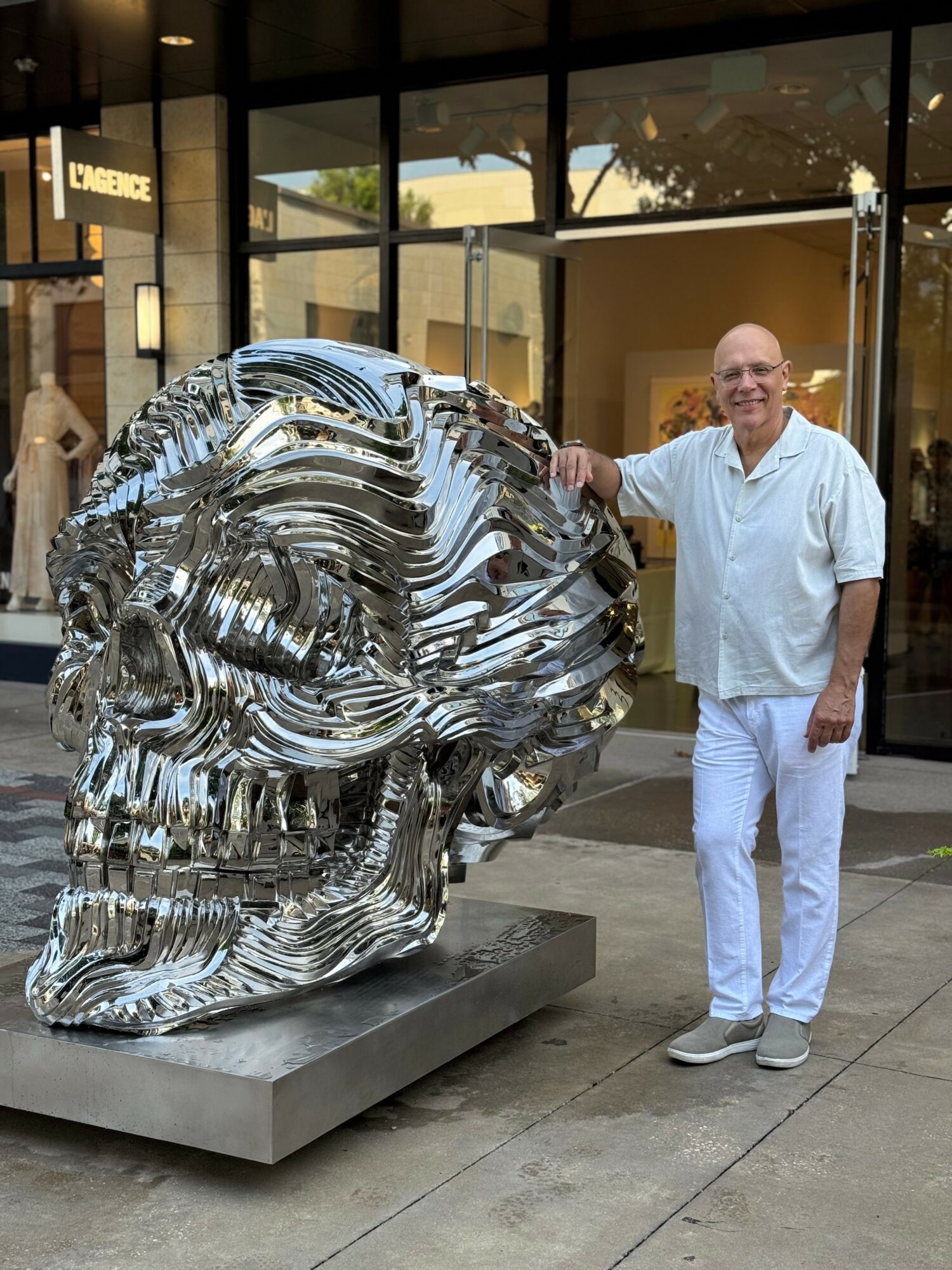
I am perhaps best known for several distinct bodies of sculpture. In my Bending the Lines series, thousands of individually cut and colored wooden sticks are assembled into flowing faces and abstract forms. From a distance, the image appears unified; up close, it dissolves into separate components. The Mask and Pixelated Forms works extend that investigation, using accumulation and fragmentation to question where identity begins and ends. In the Flow Series, polished stainless-steel ribbons create animal and human forms that seem both solid and in motion, reflecting and distorting the surrounding environment.
My daily meditation practice is fundamental to the work. Meditation has made me increasingly aware that thoughts, emotions, and identity are not as fixed as they appear. I try to give physical form to that awareness—not by illustrating meditation, but by creating objects that change as the viewer moves around them. The work asks the viewer to participate through perception rather than simply receive a fixed message.
What sets my practice apart is the combination of philosophical inquiry, technical craftsmanship, and a refusal to remain confined to one material or visual language. My early training in cabinetmaking and art restoration gave me a deep respect for precision and construction. At the same time, I am always looking for ways to make rigid materials appear fluid, or to build a unified form from hundreds or thousands of independent parts.
I am most proud that the work has continued to evolve without losing its central purpose. Over many decades, I have resisted simply repeating the pieces that became recognizable or commercially successful. Each series has required a new process, new materials, and often a new way of thinking. The continuity is not a signature style imposed on every object; it is the persistence of the inquiry behind them.
Ultimately, I want the work to create a moment in which perception becomes less automatic. When a sculpture seems to shift between stillness and movement, solidity and fragmentation, or individuality and interconnection, it can briefly interrupt the viewer’s usual assumptions. That moment of reconsideration is what interests me most.
Risk taking is a topic that people have widely differing views on – we’d love to hear your thoughts.
I do not think of risk as recklessness. For me, worthwhile risk begins when the potential for growth is greater than the comfort of remaining where I am. The objective is not to eliminate uncertainty, because that is impossible. It is to understand what is truly at stake and decide whether the risk serves the work or merely feeds the ego.
One of the most significant risks in my life was leaving Europe and building a career in the United States. I had to establish myself in a different culture and art market without knowing exactly where it would lead. More recently, the recurring risk has been artistic rather than geographic: leaving behind a body of work that had become recognizable in order to pursue a new material, process, or visual language.
That is a greater risk than it may appear. Once an artist becomes known for a particular kind of work, there is pressure to continue producing it. Galleries understand it, collectors recognize it, and the business surrounding the studio becomes more predictable. Moving away from that can mean losing momentum, confusing an audience, and investing substantial time and money in work that may fail technically or commercially.
I have taken that risk repeatedly—moving from painting into functional art, mixed media, wood sculpture, bronze, and stainless steel, and then continuing to develop new bodies of work rather than relying on one successful formula. Some projects have required years of experimentation, specialized equipment, engineering, collaboration with foundries, and considerable financial investment before I knew whether the idea could be realized at the level I expected.
Large-scale sculpture introduces another kind of risk. The distance between an idea and its final execution becomes much greater. You depend on engineers, fabricators, shippers, installers, and many technical decisions. A small error can become expensive, and a compromise made during production can weaken the entire work. I have learned that taking the creative risk does not mean becoming careless with execution. The more ambitious the work, the more discipline and oversight it requires.
Meditation has also changed my relationship with risk. Fear often presents itself as a prediction of what will happen, when in reality it is only one possible story the mind is creating. Meditation helps me observe that reaction without automatically obeying it. It does not remove fear, but it creates enough distance to ask whether the fear is warning me of a genuine danger or simply resisting change.
The greatest danger for an artist is not failure. Failure can teach you something and redirect the work. The greater danger is becoming successful at something and then being too afraid to leave it. I would rather risk an uncertain evolution than spend years repeating a version of myself that no longer feels alive.
Contact Info:
- Website: https://www.bruvel.com
- Instagram: https://instagram.com/gilbruvel
- Facebook: https://facebook.com/gil.bruvel