
Today we’d like to introduce you to Lex R. Thomas.
Hi Lex R., can you start by introducing yourself? We’d love to learn more about how you got to where you are today?
I am a multidisciplinary artist based in Lafayette, Louisiana. I primarily identify as a representational painter; however, my practice has expanded into immersive installation, performance, and mixed media. Through artmaking, I am interested in exploring inherited trauma, relational identity, and the ways internal perception and external events continually shape one another.
My formal training began in 2015 at the University of Louisiana at Lafayette, where I completed two semesters in visual arts. I later completed a Bachelor of Science in Psychology at Arizona State University, with a focus on research methods. The intersection of art and science has remained central to my practice, bringing an analytical layer into my studio process. I’m not only interested in what is seen, but in how it is processed, recalled, and interpreted. My academic background in psychology informs how I use visual elements to translate subjective experiences of perception, memory, and identity.
A pivotal shift in my studio practice occurred toward the end of 2022, when I moved from an isolated home studio practice into exhibiting work publicly for the first time. This marked a transition toward community engagement and deeper involvement in the Lafayette arts community. Within the following year, I presented two solo exhibitions: The Human Condition and Wildflowers, and received the ARTSPARK Individual Artist Grant from the Acadiana Center for the Arts. This phase of my career established a foundation built on public reception, exhibition experience, and growing artistic credibility.
As I became more active in exhibiting and collaborating, I was invited into a local arts collective where I was introduced to immersive performance and installation under the direction of movement artist and creative director Paige Barnett Kulbeth. A year later, I co-directed my first performance and installation with artist and curator Bethany Lejeune, which further shaped my understanding of audience participation as an active component in the construction of space and meaning. From that point forward, I have continued to explore how viewers can become participants in the spatial and conceptual formation of artwork.
In 2024, I worked in preparator and arts administration roles while continuing to build my studio practice. During this time, I met preparator and curator Emma Sonnier, and together we co-founded ARCHIVES Exhibitions. Through this work, I developed a deeper understanding of the labor involved in sustaining artist-run spaces and the structural gaps within regional arts infrastructure. It also made clear how often self-sustained creative labor can lead to burnout when it is not supported by broader systems.
More recently, I have taken steps to reestablish balance between my studio practice and community work. While community engagement remains an important part of my practice, I have returned to prioritizing my time in the studio, alongside my mental & physical health. My current focus is on maintaining a practice that is both creatively rigorous and sustainable at its core, so I can continue contributing to the communities I care about without compromising my well-being.
I’m sure it wasn’t obstacle-free, but would you say the journey has been fairly smooth so far?
My practice emerged within the reality of living in the rural countryside for much of my life, where lack of access and physical distance set limits on the scope of my work. During that period, I balanced multiple forms of labor, including work as a barista, student, and educator, while developing my studio practice within the cracks of my schedule.
After relocating and establishing myself within the Lafayette arts ecosystem, the challenges shifted toward long-term sustainability. I worked to maintain a consistent studio practice while also holding roles that support the broader arts community.
Navigating a regional Southern arts environment often means working within self-sustained structures. This has required persistent resourcefulness and careful attention to energy/time allocation. Over time, it has also shaped how I think about boundaries, burnout, and how those conditions directly impact the ability to sustain a fine art practice.
Thanks for sharing that. So, maybe next you can tell us a bit more about your work?
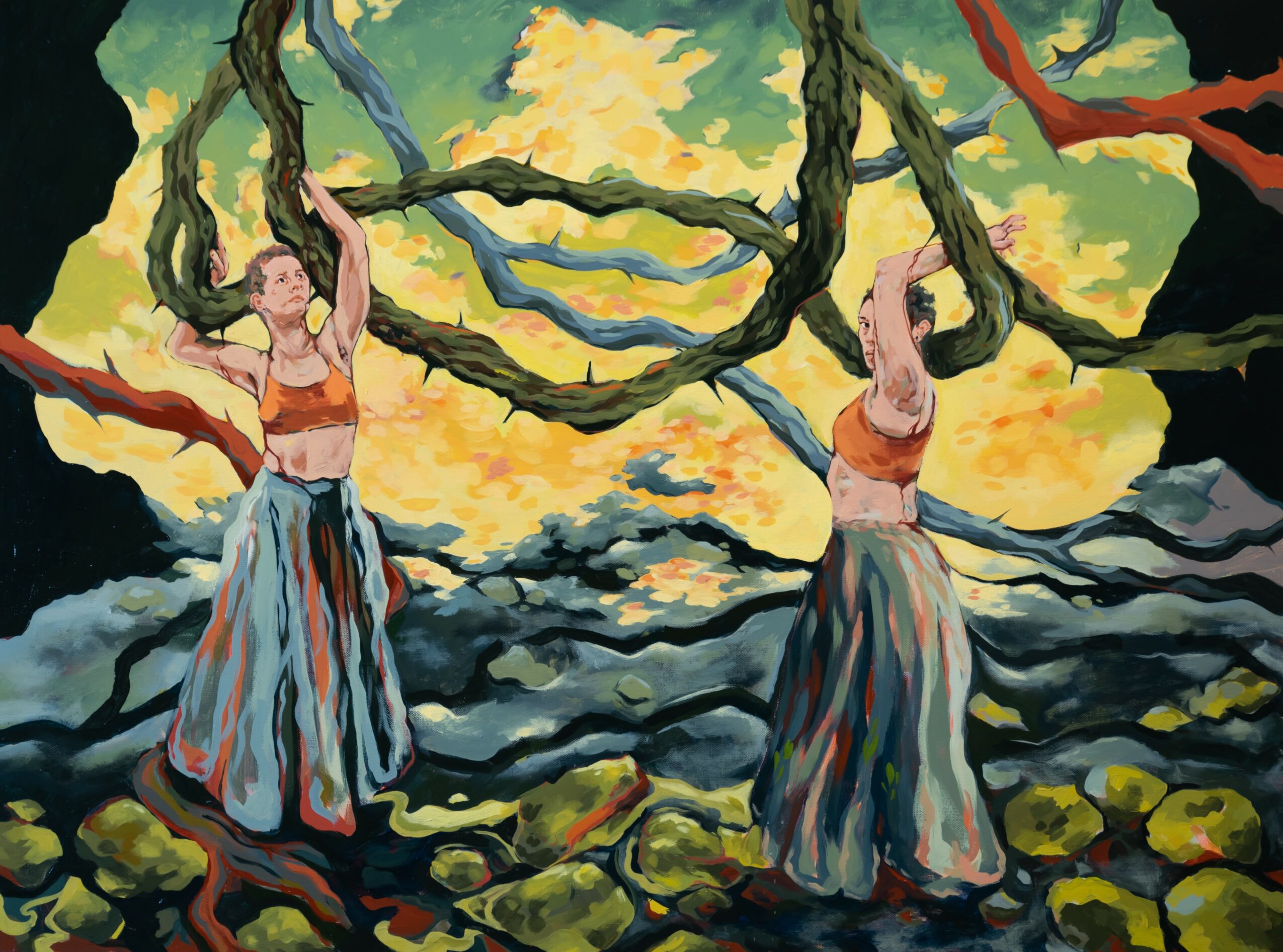
I am drawn to psychological states that are deeply felt but difficult to articulate directly, including attachment, dissociation, intimacy, and estrangement. Painting becomes a way of testing how these conditions can be translated into visual language while retaining their uncertainty. There is always a gap between internal experience and external reality. I am more interested in exploring that gap than resolving it.
What I am most proud of is the community I have built and the support system around me. I am proud of creating a life centered in creativity while surrounded by people who understand the demands of this path. For me, success is not only direct output of finished work, but working to maintain the conditions that allow the work to continue.
Few artists engage the human figure in the way that I do. I primarily work with the human figure, and my visual language is often recognizable before any exhibition label. My approach sits between detailed rendering, expressive mark-making, and a slightly detached sense of reality, creating a space between observation and interpretation.
Alright so before we go can you talk to us a bit about how people can work with you, collaborate with you or support you?
People can support my practice through collecting my work, commissioning pieces, and engaging with exhibitions and projects as they emerge. Collaboration is also important to me through working with curators, writers, and other artists of all disciplines to develop exhibitions, installations, and conversation around the work. Sharing my work, making introductions, and helping connect it to new spaces and audiences are also meaningful forms of support that help sustain and expand the practice over time.
More of my work can be found at www.lexrthomas.com or on Instagram @lexr.thomas. Commission inquiries for custom portraiture can be directed through LRT Studio on Instagram @studioLRT.
Contact Info:
- Website: https://www.lexrthomas.com
- Instagram: https://www.instagram.com/lexr.thomas/
- Facebook: https://www.facebook.com/lexrthomas.art
- Other: https://www.instagram.com/studiolrt/