





 Today we’d like to introduce you to Bianca Springer.
Bianca, we appreciate you taking the time to share your story with us today. Where does your story begin?
I was working at the University of Houston when my husband and I decided to start our family. Our first child was born prematurely, and I became a stay-at-home mom. I had time at home with her, and I was looking for a creative outlet that wouldn’t disrupt her routine. I was interested in clothing options that were fun and unique. When I saw the cost of what was available at stores, I immediately knew I had to unpack my sewing machine. I was raised in a family of makers, but it was always very utilitarian in my mind. I didn’t necessarily see making as a way to express myself creatively until my daughter came along. I had the foundations to begin, so I started making coordinating outfits for us. We frequently received compliments on our outfits, and the name of my blog, “Thanks, I Made Them,” was born. The subheading, “Sew Can You,” was added when I began teaching sewing lessons locally.
My daughter was on the playground one day when one of her white playmates told her the way she was wearing her hair looked weird. She typically wore her hair in braided ponytails. On this day, she chose to wear her curly locks in a voluminous Afro. Her feelings were hurt by what was said. Though we discussed it thoroughly, I knew I had to do something tangible to help her feel better. My initial thought was to buy some fabric with girls with natural hair like hers and to make her something. Together, we searched online and in stores, and we were disheartened to see only images depicting little white girls with pigtails in available fabrics. This lack communicated to my daughter her level of perceived importance in the world. I had never designed fabric before, but this need inspired me to make stencils and fabric stamps to represent our hair. She felt seen, loved, and proud of her hair and fabric. I used my blog to encourage inclusion and to highlight the lack of diversity in the sewing and craft industry.
Our children are older now, and they are very aware of systemic racism’s existence and impact. The persistent and pervasive nature of it leads us to question what can we do. We have taught them that it is important to use their voices to speak up for themselves and for those who need support. Use whatever tools you have to do so. For me, one of those tools is creativity. As I created more, my social media following and opportunities grew. I began writing articles and projects for Sew News, Creative Machine Embroidery, and working with industry brands. I facilitated conversations with fabric companies, with sewing and quilting organizations, and with industry brands about making needed changes.
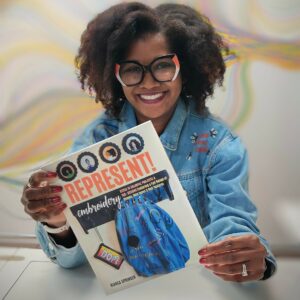
One of these conversations was with C&T Publishing regarding the lack of diversity in the content, authors, and imagery in their publications. They heard my concerns, and, after working with them over time to examine their organization, we partnered for my first book, Represent! Embroidery: Stitch 10 Colorful Projects & Designs Featuring a Full Range of Shapes, Skin Tones, and Hair Textures. The book is primarily an embroidery book, but, as an omni-crafter, I could not escape my garment-making roots. There is a blending of techniques and media in the projects. It was exciting to contemplate ways to integrate leather sewing, fabric applique, crayon shading, and sewing with the hand embroidery techniques. I enjoyed sourcing fibers like knitting yarn and crochet threads while thinking beyond embroidery floss, particularly when designing hair.
Would you say it’s been a smooth road, and if not, what are some of the biggest challenges you’ve faced along the way?
Working to fill gaps of representation in the craft is difficult and emotionally draining work. I am inspired to make things that excite me and expand me creatively. Some of the things that I make don’t necessarily speak to my racial and cultural identity. It may involve upcycling vintage textiles and reimagining them for a modern look. It may involve a creative take on machine embroidery for magazine work or quilted textiles as wearable art. I am offered invitations to spaces and opportunities that are predominantly underrepresented by Black people. I don’t have the privilege of believing or feeling flattered that I am there solely based on my work. In these spaces, I feel it is my responsibility to ask questions about the lack of diversity and representation. I have to ask about the lack of diversity in their social media, in their publications, and in their promotional videos. Does gatekeeping limit participation? Does a hostile environment make participation undesirable? Am I a replacement face for the previous Black maker that was mistreated and who no longer feels welcome? Rather than change their organizational behaviors, are they simply changing the face of the Black maker. I need to know why representation is lacking, and I need to know why they want me to be a part of the space.
The mere act of asking these questions challenges these organizations to see what I see. Often, these organizations attempt to shift my responsibility from being a creative in that space to then becoming an educator and recruiter into their space. Not only do they want me for my creative work, but also, they want me to carry the mantle as a diverse face in their space. I am constantly having to evaluate my creative value against tokenism. For me, it goes beyond the privilege of imposter syndrome. I am not spending time questioning whether what I do is any good. I am having to question if my work and image are being used for some perceived diversity clout for some monochromatic organization, brand, or event. I am at the point in my creative journey where I refuse to have this internal dialogue alone. I am refusing opportunities where the answers are insufficient. There are some opportunities that I take because I see it as an open door for me and the next person, but it is tiresome to be the trailblazer or the only one, two, or three in the room.
On an individual level, I struggle with the shock and surprise white people share about their willful ignorance of many ways people of color are marginalized in this country. The Black experience is not a monolith, and the scenarios I share in Represent! Embroidery shines a light on just a small portion of our experiences. Those experiences have often been met with tear-filled exclamations, “I didn’t know that still happens!” I ask, “How can you not know?” The murder of Black men, women, and children by police and civilians is transmitted ad-nauseum on the news and social media. I struggle with the lack of intellectual curiosity and empathy that would naturally foster the impetus for these people to increase their knowledge. When their ignorance is revealed, I struggle with those who want absolution for doing nothing or applause for doing the bare minimum. With book bans, the removal of diversity programs, and exclusion of African-American history education in schools, it signals to others that there is no need for them to know more. Some see that as a license to further dismiss or diminish the continued struggles of others.
Thanks – so, what else should our readers know about your work and what you’re currently focused on?
I am a garment maker, pattern designer, magazine writer, and sewing instructor. I am the creator of sewing pattern weights to increase sewing efficiency. I collect and sell vintage sewing patterns for lovers of sewing retro styles. My garment making is characterized by fun, bold prints in simple silhouettes. I love thrifting, resale, and estate sale shopping. I love to reimagine previously discarded textiles, quilts, and quilt tops to give them new lives. I think my ability to envision the beauty in underrated things and to make them current and modern sets me aside from others. I am most proud of being an example to my children on how to use your voice to affect change within a problematic system.
Can you share something surprising about yourself?
I love complex crime books and television dramas. I love being drawn into the plots, getting to know the characters, and attempting to solve the crimes. I love to predict the outcome and am ridiculously gratified when I figure them out. Because I am good at solving the crimes, I am beyond excited when the writers manage to get one over on me, and I get it wrong. I will re-watch or re-read to see how they did it. I enjoy stories set in foreign countries which helps me expand my worldview and gives me insight into cultural similarities and differences there.
Contact Info:
- Website: www.thanksimadethem.com
- Instagram: thanksimadethem
- Facebook: https://www.facebook.com/Thanksimadethem


Image Credits
Bianca Springer
Justin Springer
Kelley Sweet Jensen