




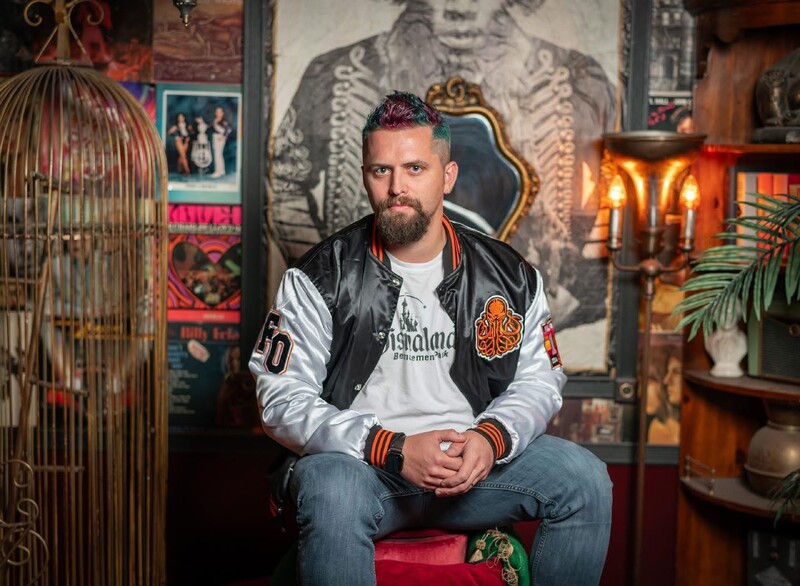
Today we’d like to introduce you to Cameron Mitchell.
Hi Cameron, so excited to have you on the platform. So before we get into questions about your work-life, maybe you can bring our readers up to speed on your story and how you got to where you are today?
Though I am 35 now, I had the idea for the film Disposable Humanity when I was nine years old. My parents were presenting on the history of American Eugenics in Germany and someone in the audience thought it would be worth mentioning at the end of the presentation that they also did this “not far from here”. Being the endless enthusiasts and advocates for disability inclusion that we are, my family made the effort to visit the nearby T4 sites of Hadamar and Bernburg. We learned at the memorials that Aktion T4 was the original program that targeted over 300,000 disabled people and resulted in the invention of the gas chamber and training of killing staff that made the Holocaust “final solution” an actual proposal. As a young aspiring artist, I sat down inside the gas chamber of Bernburg and began drawing the room. Little did I know what that journey would become. And we’re still going strong. To follow along as the film becomes available around the world, sign up for our mailing list at www.disposablehumanity.com
I’m sure it wasn’t obstacle-free, but would you say the journey has been fairly smooth so far?
Going to Germany repeatedely over the next several years felt anything but a struggle. We would take students, peers, as well as other teachers and professors to the sites. In a way, that first moment always stuck with me of stumbling upon the T4 program at Bernburg. I made a promise to myself that I would come back there and make a film about it someday. I think I got this idea from the fact that my mom was there filming us with a camera. When they later made a film with the help of their grad students, I watched that film (A World Without Bodies) repeatedly. I really enjoyed how our visit had in a way made a narrative foil that someone could follow and touch the past with it.
Thanks – so what else should our readers know about your work and what you’re currently focused on?
I am known for making films that seemingly no one wants made. Films about so-called disabled people. The film Disposable Humanity is my magnum opus of these works but I have made many award winning short films along the way such as my first narrative short The Co-Op which was programmed in over 20 film festivals around the world and ended up at Slamdance. I then followed up with the PBS doc short Elsa which was a companion piece to their Hellen Keller documentary intended to present a modern Deafblind role model so we would stop just referencing Hellen Keller like she was the only deafblind person who ever existed. I am most proud of the fact that the films I make are about a subject that many film festivals resist and that distributors are afraid of. People should know that these films about disabled people are silently contraband and that they should seek them out regardless.
Can you talk to us about how you think about risk?
Risk taking in my mind is the creative form itself. When one takes a risk, they are taking a chance on something that hasn’t been seen or done before. This is my motto when I make films. I like to say that Susan Sontag gave me it. Her essay On Photography still sticks in my brain from film school. I loosely interpreted Sontag’s position in On Photography to mean that we should seek images that we haven’t seen before, that preferably are steeped in ethics and morality. The piece was a critique of the Vietnam war at the time, and she walked back many statements in a follow-up piece by the same name, but I think the original piece still holds these ideas strongly that photography should go places that we don’t see, that we need to see, and to not over-saturate us with abstract violence.
Contact Info:
- Website: https://www.disposablehumanity.com
- Instagram: https://www.instagram.com/disposablehumanity/
- Facebook: https://www.facebook.com/DisposableHumanityFilm