





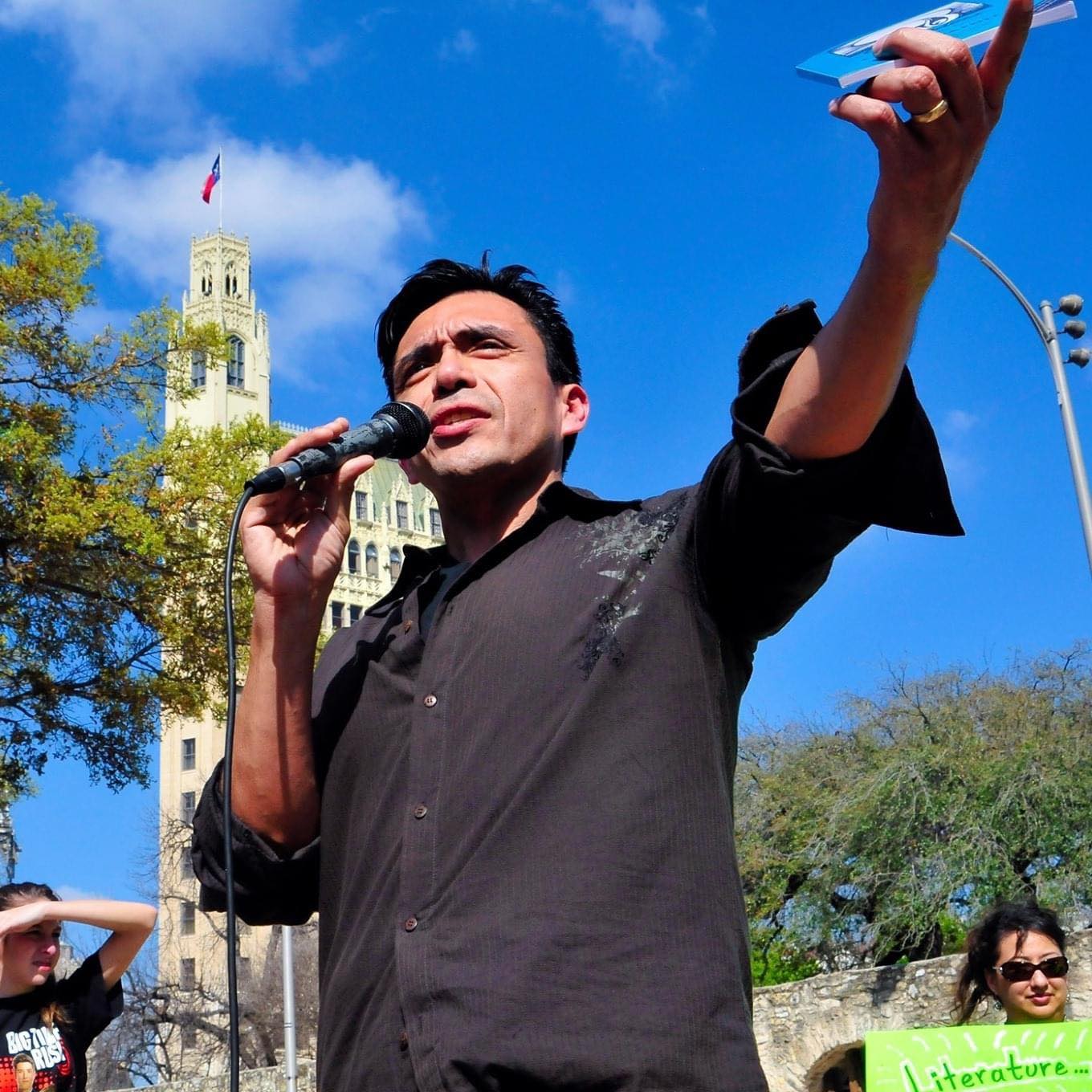
Today we’d like to introduce you to Tony Diaz.
Hi Tony, so excited to have you with us today. What can you tell us about your story?
I was born with a facility for language. It served me in my first job-translating the English of the outside world into the Spanish of my household.
However, I also grew up in a family whose vision helped me overcome barriers to art and culture.
There is one line that dramatizes the extent of these obstacles: “Poetry doesn’t make money.”
That sentence is intended to sentence our senses to cents. Yet, we hear it all the time.
I aim to write about Cultural Capital to defy sentences like this.
Because here is the truth: poetry does not create direct capital, but poetry creates a gold mine of Cultural Capital. And our community thrives on it.
We will not be kept from it, but our community needs to profoundly understand the power of Cultural Capital, and they must know that others actively attempt to make us relinquish our voice.
At the most basic level, teachers, parents, and even editors tell potential poets and writers that poetry doesn’t make money as if they are repeating a universal truth.
Most folks might consider this a harmless statement. The harmful part is that it’s a stereotype that has gained traction and is repeated more often than poems are probably read.
Mind-altering poetry and prose reveal to us what is missing. And then we write about what we see in our minds. And we dispel that myth that poetry does not pay because we are proof that poetry creates Cultural Capital. If we invest that Cultural Capital into our community, we are poised to accelerate it for the good of not just our community but for humanity.
I have seen this happen before my very eyes.
In 1998, I founded Nuestra Palabra: Latino Writers Having Their Say in the party hall of Chapultepec Restaurant in Houston’s Montrose neighborhood.
At the time, people did not quite say to me “Poetry Does Not Make Money”, but instead they used a lot of synonyms and euphemisms.
The worst thing I would hear, even from other Latinos, was that our community just was not interested in literature.
Let that sink in. Our own community deeply believed we did not possess the basic humanity to want to tell our or hear our story. That is profound damage. I would simply tell them they were welcome not to attend, but this train was moving, and I kept looking for other Cultural Accelerators who were ready to unleash Aztec muses.
From the outside world, I would hear that there were not enough Hispanic writers in Houston to sustain a series.
I had just become the first Chicano to earn a Master of Fine Arts in Creative Writing form the University of Houston. I moved here specifically for that. This was shocking to me. I always wondered why Houston had to import Mexican Americans from Chicago when, being occupied Mexico, it had plenty of its own. Examining Cultural Capital peels the structural issues that explain this.
MFA students are taught to flee to New York to starve as soon as they graduate and try to get an obscure novel published by a small New York press. I looked into that and ascertained that NYC already had enough writers, actors and hit men. Instead, I decided to invest my Educational Capital into Houston’s Cultural Capital.
This inspired me to create Nuestra Palabra: Latino Writers Having Their Say in April of 1998 in order to peel away the barriers to books and our voices. Nuestra Palabra has been thriving ever since.
When I think of the 2.6 million Latinx students in Texas public schools right now, I envision 2.6 million poets and writers.
But don’t be scared. Even when they are all freed into their Cultural Capital, the number of poets and writers will probably stay the same percentage-wise, but they will have an army of readers who have become doctors, lawyers, professors, accountants, politicians, board members, and so on, and so on, and so on.
If you don’t believe me, you simply need to refer to the research by Chicanas and Chicanos submitted as evidence in court to overturn Arizona’s un-American ban of Mexican American Studies. If you need more proof…
Sociologists take too long to explain the dagger at our throat.
Writers provide vivid renditions of the tip of the pyramid but must write novels to explain the base.
The poets make us sharply feel the import.
I bring all three to this battle for Cultural Capital and have 10 more waiting in my car.
Adapted from “Poetry Doesn’t Make Money” by Tony Diaz, published at www.LatinoRebels.com and included in the book THE TIP OF THE PYRAMID: CULTIVATING COMMUNITY CULTURAL CAPITAL by Tony Diaz.
Would you say it’s been a smooth road, and if not what are some of the biggest challenges you’ve faced along the way?
I didn’t read a novel written by a Latino until I was a junior at De Paul University, taking a Creative Writing Course with Professor Ted Anton, a graduate of the University of Iowa’s Writers Workshop. He would ask me why I didn’t write about my family, my story. I remember wondering if that was even allowed since I had never seen that in a book.
Professor Anton handed me “Down These Mean Streets” by Piri Tomas.
That was the first book I read that switched back and forth from English to Spanish, to Spanglish to slang, then back, in a fast, furious and poetic pace. It was set in the rough urban sprawl of New York that looked and smelled like the South Side of Chicago. It was packed with crazy confrontations and barriers. If we can just survive the weekend, the book showed, we can get to school on Monday to keep fighting.
Books are dangerous – and crucially important. They make us dream big and believe we can deliver.
It worked for me. In 1994 I became the first Chicano to earn a Master of Fine Arts in Creative Writing at the University of Houston’s Creative Writing Program. It was there I first met in person and chilled with a real life Chicano author, Dagoberto Gilb, when he had become the first Chicano to win the Pen/Faulkner prize as well as a ton of other awards that year.
In 1998 my first novel “The Aztec Love God” was published. That same year I founded the group Nuestra Palabra: Latino Writers Having Their Say (NP), to promote Latino literature and foster literacy. NP would go on to host the release of Dagoberto’s book “Woodcuts of Women.”
But years later, in January of 2012, that book, along with Dagoberto’s book “Magic of Blood,” were among the 84 works confiscated from classrooms in Tucson, Ariz., after Mexican American Studies had been prohibited in that state.
That’s when I and 4 other members of Nuestra Palabra- Lupe Mendez, Liana Lopez, Bryan Parras, and Laura Razo- first became Librotraficantes or book smugglers. During our March 2012 Librotraficante Caravan, we took books from the prohibited Mexican American Studies curriculum back into Arizona.
We returned to Texas and formed part of a statewide coalition that advocated for the Texas State Board of Education to implement a Mexican American studies elective to get more books into the hands of our youth. There were many who shared stories about what our literature and history has meant to them, and how it has changed their lives.
And the first person to testify was Dagoberto Gilb.
We went to Austin looking to implement Mexican American Studies (M.A.S.) We came back with the Texas Plan that allows us to control the content of our courses, yet still have the courses recognized and advertised as electives by the state. It also allows us to get the textbooks needed for not just Mexican American Studies, but also African American, Asian, and Native American Studies.
These courses blossomed for a decade.
Our courses and writers are now being expunged from universities across the state, in this new dark age for intellectual freedom.
Adapted from the essay “Voices: The American Dream Through Our Books” by Tony Diaz, published on www.NBC.com.
Thanks – so what else should our readers know about your work and what you’re currently focused on?
I am a writer.
Some folks assume that I am advocating for only my community to tell their story.
I am working towards a world where everyone can tell their story.
This involves understanding that you have a story to tell and that your story is important, that your words will touch the hearts and minds of others.
This is the basis for the power of books. This is why there are forces at work to ban them.
I strive to peel away, and some times, shatter, the barriers to books and our voices.
We’d love to hear about any fond memories you have from when you were growing up?
People often ask me why I’m so passionate about books and education. I am usually shocked that more people aren’t.
I have to keep in mind that not every one has had their life changed through education, and not everyone has had to fight tooth and nail for it.
In my case, books have made the American Dream a reality.
My parents were migrant workers. I’m the first of my family to not only go to college but to attend graduate school. In one generation – through books and education – my family has gone from the farm fields to the national stage, where I have had the honor of representing my community and advocating for Latino literature and history in our classrooms.
I have a gift for language. I get it from my mom. She never went to school, but she taught herself how to read. She would keep all of our family spellbound when she told stories about her life in Mexico or in the fields, or about the misadventures of family members navigating their new life in Chicago.
I knew language was powerful, because as early as third grade I was translating English into Spanish for my father. I remember salesmen looking down at him, judging him because he needed me to understand. That’s when I learned. I would remind a clerk that he didn’t speak Spanish, so he too needed me to make a sale.
Language helped me protect my family. Language helped me defend myself. Maybe that’s why I always wanted to be a writer.
My first poem was published in sith grade, over the lunch hot menu touting “Sloppy Joe Burgers” at St. David’s Catholic School on the south side of Chicago. Overnight, teachers who had ignored me knew my name and would walk up to me to talk about my writing.
Same me, same school, different universe, all from one poem.
Adapted from the essay “Voices: The American Dream Through Our Books” by Tony Diaz, published on www.NBC.com.
Pricing:
- Sponsor The Houston Text Fest
Contact Info:
- Website: https://www.NuestraPalabra.org
- Instagram: @librotraficante
- Facebook: https://www.facebook.com/TonyDiazElLibrotraficante/
- LinkedIn: https://www.linkedin.com/in/tony-diaz-531b42a/
- Twitter: @Librotraficante