


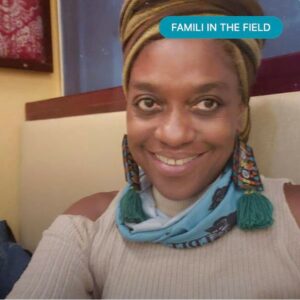
 Today we’d like to introduce you to Busi Peters-Maughan. They and their team shared their story with us below:
Busi Peters-Maughan
Busi L. Peters-Maughan is an activist, educator, world traveler, motivational speaker, entrepreneur, and Reentry/Criminal Justice/Hip Hop Artivist.
She began her teaching career in the fall of ‘91. Since that time, she taught for years in various places, such as Nairobi, Kenya, Addis Ababa, Ethiopia, Khartoum, Sudan, Brooklyn, New York, and Houston, Texas. Her travels encompass thirty-six (36) countries and thirty-five (35) US states across which she runs her own import/export company Sikawaida Imports, and the Founder of WHEW Women Healing and Empowering Women, a 501(c) (3) reentry social purpose venture confronting the intersection issues of Melanin dominant and Indigenous women in prison, and how it relates to sexual abuse, family violence, homelessness, negative impacts of misogynistic lyrics, objectification of women, and the glorification of prison culture in Hip Hop.
She holds a Bachelor’s Degree in Information Systems University of Houston-Downtown and a Masters in Multicultural Studies from the University! of Houston-Clear Lake. She is a wife mother of two, and she endeavors to share her own unique perspective on the world as she has come to know it as a native from the birthplace of Hip Hop the Boogie Down Bronx, Melanin Dominant citizen of the Universe born in Amerikkka, and as a child of the African Diaspora.
We all face challenges, but looking back, would you describe it as a relatively smooth road?
Of course NOT. Life is a winding road with twists and turns, so of course that is what my life has been to. As the founder of a social business venture that is addressing taboo topics such as, rape, molestation, and incest, if is very challenging to support. Amerikkka is a RAPE Culture build on the back of Sex & Labor Trafficking… The Middle Passage was the first Sex & Labor Trafficking Ring founded by the United States of government. This country had sex & breeding farms, buck busting, which entailed sexual abuse and rape of African descent men and boys, and countless ways of sexual deviance that directly connects to the issues faced around the world today like the Mass Prison & Military Industrialization, and the continuation of bodies being stolen and sold for the sex & labor exploitation.
Issues that affect lower socioeconomic backgrounds and non-European descent folks are all too often invisible, not respected, and ignored. People like myself are patronized while being praised for doing the work we do. More importantly, we are not given the resources. Instead, larger organizations get monies for the work of grassroots organizations like WHEW Women Healing & Empowering Women are on the ground in the trenches, confronting and pushing back on the status quo. Our biggest challenge is getting people to at the very least discuss these difficult topic, attract people contain the skills and financial backing to address the plethora of challenges that persist.
Thanks – so, what else should our readers know about your work and what you’re currently focused on?
WHEW Women Healing Empowering Women a 501(c)(3) arts healing reentry program founded as a grassroots organization in 2003 and received IRS status in 2007 to confront the intersectionality of women who are formerly incarcerated, unhoused, and challenged with domestic violence, i.e., molestation, rape, and incest using. We started local and began our global healing work. Our humble beginnings started in the Historic Third Ward and Sunnyside communities in Houston, Texas, and have provided services in parts of the state, out-of-state, and internationally.
Using the arts as a healing tool, WHEW Women Healing Empowering Women is on a mission to address interconnected challenges women face with a focus on BIPOC communities addressing former incarceration, homelessness, and domestic violence, starting locally and going global.
WHEW’s vision is to be an organization committed to empowering women, families, and communities globally through artistic, economic, educational, environmental, and cultural programs that work to end and eradicate sexual abuse, prison recidivism, homelessness, gender and ethnic biases, inter-generational poverty, the lack of access to adequate, and sufficient education.
WHEW empowers women and girls by addressing reentry, sexual and violent abuse, & the unhoused by promoting ancient African and Indigenous spiritual and cultural customs and rituals for (w)holistic healing and living in harmony within self and outward with others and the planet earth.
We’ve been given credit for being bold to confront taboo topics at the root of BIPOC women/girls & men, their families, and communities who are imprisoned due to the foundation of being stricken with molestation, rape, and incest plaguing the community. An epidemic that has debilitated the mind, body, and soul of too many, which has been historically around much longer than Covid, and has continued to have catastrophic numbers of victims go through life making unhealthy choices directly connected to the sexual abuse. There have been statistics that state violations can happen at the tender age of 2 years old.
We’ve been given credit for being bold to confront taboo topics at the root of BIPOC women/girls & men, their families, and communities who are imprisoned due to the foundation of being stricken with molestation, rape, and incest plaguing the community. An epidemic that has debilitated the mind, body, and soul of too many, which has been historically around much longer than Covid, and has continued to have catastrophic numbers of victims go through life making unhealthy choices directly connected to the sexual abuse. There have been statistics that state violations can happen at the tender age of 2 years old.
That we are unique because we are amongst the few organizations approaching the challenges of our advocates by using solutions that are grounded in ancient customs, practices, and rituals using spiritual beliefs of African and Indigenous ethnicities, which is not a mainstream approach. The exact opposite is that we do this as a way to reclaim the practices that are grounded in the ways of our ancestors to connect to our true self and purpose of being, to live a harmonious life with others and Mother Earth and Father Sky.
We have been credited for being trailblazers as Change Agents who are unapologetically promoting the importance of spiritual inner-work first to heal and empower the whole person before addressing the issues that are all too often addressed prior. Such as housing, job training, employment placement, etc. The approach is indicative of pouring perfume on an unclean body or providing a band-aid on a shotgun wound. Those direct services we are now beginning to address after focusing our initial years using a bottom-up, inside-out approach.
WHEW is most proud of The BEAH Ripple: Sexual Healing Grief Ritual Movement, a multilayered initiative centered around women and girls’ internal, cross, and intercultural relationships. WHEW (Women’s Healing and Empowerment Works) firmly believes that fostering healthy relationships among women is the key solution to address global societal challenges. The movement aims to cease sexual violence and the senseless killings of unarmed Indigenous/Melanin-dominant people by exploring the connections between perpetrators and victims, particularly examining the ancestry of those responsible for violent acts.
WHEW is committed to examining the historical context of sexual violence and land exploitation that has affected Indigenous/Melanin-dominant communities. Through a nine-month program conducted via Zoom virtual meetings, participants engage in a transformative process:
Collective Poem Viewing: Participants come together to view a collective poem that serves as the foundation for the subsequent workshops.
Formation of Four Groups: Groups are organized based on ancestral backgrounds (Melanin Dominant/Indigenous and Caucasian/European) to create a safe space for inner healing work.
Poetry and Prenatal Workshops: The groups dissect, analyze, and process their experiences through poetry and prenatal workshops, fostering self-reflection and healing.
Community Workshops: Each participant commits to teaching a workshop in their community to share their learning and shift internal and external relationships.
Interpretative Performances: Participants utilize various artistic mediums to create interpretative performances, expressing their journey and insights.
Culminating Events:
The project culminates in a two-day event in Galveston and Houston, TX:
Day 1:
Morning (Galveston, TX): Sexual Healing Grief Ritual using ancient traditions and practices for healing and eradicating sexual abuse and unhealthy relationships.
Afternoon (Houston, TX): Community Grounding Medicine Rituals, including Elders’ Wisdom and Connect the Dots: Sexuality + Nature + Spirituality = Oneness.
Day 2:
Evening (Houston, TX): Finale Interpretive Performances of Beah Richards’ poem, showcasing the profound transformation experienced by the participants.
In addition, this past Spring “Beah Ripple,” an exhibition/workshop opened Saturday, April 1, 2023, at the Community Artists’ Collective, was developed and curated by Busi L. Peters-Maughan. The exhibition issued a call to action to be a part of a sexual healing grief ritual and to provide women a safe space to release and discuss sexual abuse between men and women, both mentally and physically.
Works of artists, both visual and performing, were included in the presentation.
Peters-Maughan’s inspiration to create this exhibition was inspired by Beah Richard’s poem, “Thus a Black Woman Speaks: Of White Womanhood, White Supremacy, and Peace,” and is offered as an art healing tool for addressing sexism, racism, sexual abuse, mistrust and the monstrous relationships between women of different ethnicities.
Peters-Maughan, an activist, educator, and Reentry/Criminal Justice/Hip Hop Artivist, explains that “This exhibition connects the dots between women of European descent, male patriarchy and other issues rooted in oppression, colonization and the captivity of melanin dominant/indigenous bodies.”
Workshops with discussions based on the artist’s statement was held every Saturday from 1 to 5 p.m. throughout the exhibition, which continued through April 29. A reception, artist talk, and program with dance poems was also held Sunday, April 23, from 1 to 5 p.m.
In conclusion, moving forward the BEAH Ripple Movement Exhibition will be an added component of the annual movement.
If we knew you growing up, how would we have described you?
At the age of 4 it was the first time I ever flew on a plane. Madear, my maternal grandmother from Mobile, Alabama, had to return home from the Bronx, New York. My immediate family and I lived in the “Boogie Down Bronx,” the birthplace of Hip Hop, which is where I was raised. I’m the youngest of three children, and my parents relied on Madear to take care of us while they were at work. I am the first grandchild of my entire family’s generation to make that pilgrimage to our mother’s and grandmother’s homestead. Madea, aka Georgia Lee Byrd was a part of that great wave known today as “The Great Migration.” or “Black Migration.”
Personality I have always been adventurous, curious, and a desire to learn about the unknown. 1965, the year of my birth, was met with multiple protests and riots known today as the “Burn Baby Burn” years. Riots took place in various cities, predominantly in the Melanin dominant communities like Harlem, Watts, Newark, Baltimore, Detroit, Chicago, etc. My parents’ wedding reception was held (just some years prior) at the same place Malcolm X was assassinated, the historical Audubon Ballroom. Even more ironic is the fact that his body was taken to the same hospital, Columbia Presbyterian, where my mother was waiting to have me. I was born four days after his murder on February 25, 1965.
From the time I was a little girl, I always had a wandering and curious spirit, wanting to see other neighborhoods and do all types of fun things. It was just too boring to just stay in front of the building, which was mostly expected of me to do. Don’t get me wrong, my neighborhood was the bomb to hang out during my preteen years. I often tell people that the two Spike Lee movies, “Crooklyn” and “School Daze,” capture periods in my life so perfectly. We jumped double dutch, played Duck-Duck-Goose, Tag, Kick-the-Can, football, Hot-Peas-and-Butter, Skelsies, etc.!!! Yes, it was often a BLAST right outside, but that STILL didn’t stop my insatiable curiosity for knowing and, more importantly seeing what is going on in other parts of the city in various neighborhoods. This was extremely easy in New York because I could walk or hop on a train or bus to get around. The Iron Horse as we used to call it was easy to use to get downtown. When I was wandering around not far from my area, my options of choice were Boston Road, 228th & White Plains Road. I went to P.S. 121, which was right up the street from my house. At that time, I would go up the hill and to Boston Rd. to walk around and wander about, which drove my family Coo Coo for Ko-Ko Puff Puff Puff! By the time I went to Michelangelo I.S. 144, I was hanging out a lot in an area that is a huge part of my childhood, “The Valley,” where my junior high school is located. Many of my friends who attended my same school lived there. I just found it to be more aesthetically pleasing fun, and most of all, I did NOT desire to constantly be in front of my building.
People are brainwashed and have preconceived notions that are stereotypical ideas about the Boogie Down Bronx. They have no clue that the entire Bronx is not the South Bronx. Nor does it look like the South Bronx. For the most part, the area that I lived in is very nice. It’s hard for some people to believe that they’re still in New York City.
My interests include movement, especially dancing to House Music, Travel, Travel TRAVEL, and the empowerment of people who have been silenced and treated as though invisible due to colonization. Captivity, disconnected from Spirit, and complete GREED.
Pricing:
- We sell conscious concept T-shirts prices vary from $15 -$35
- Sikawaida Imports Drum bags range in price fro m $55 to $85
Contact Info:
- Website: www.whewnow.org
- Instagram: @WHEW_NOWORG
- Facebook: Women Healing & Empowering Women
- Linkedin: Busi Peters-Maughan
- Twitter: @WHEWNOWORG
- Youtube: @Busi Peters-Maughan
- Other: https://www.youtube.com/watch?v=k2BgqjmZ6aU&t=22s


Image Credits
Busi Peters-Maughan
Taina Lyons