





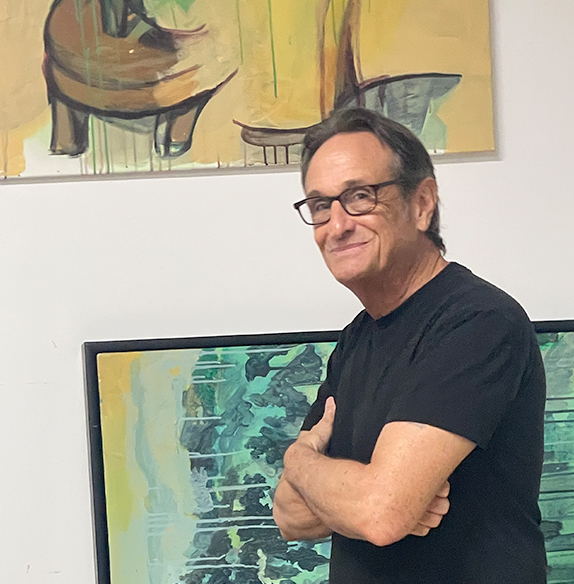
Today we’d like to introduce you to Toby Rosser.
Hi Toby, it’s an honor to have you on the platform. Thanks for taking the time to share your story with us – to start maybe you can share some of your backstory with our readers?
My father was an illustrator and teacher, so my childhood home had an abundance of art materials and art books.
Exposure to these resources and living in an isolated rural environment made creativity a survival tool.
The exposure to art literature and design publications influenced my interests in the visual arts and eventually led to my attendance at the Pratt Institute in New York City.
After receiving a BFA from Pratt Institute, I spent close to 20 Years in NYC as an art director and visual designer.
My obsession with painting and sculpture remained a constant preoccupation and eventually led me to the city of Houston in 2020, where the creative community and cost of living were much more acceptable compared to NYC.
I presently maintain the Toby Rosser Studio at 2000 Nance Street, which houses several art studios, architecture firms, design studios, and a theatre company.
I’m sure it wasn’t obstacle-free, but would you say the journey has been fairly smooth so far?
The most persistent challenges I have experienced involve finding ways to develop and present the most engaging visual object possible for the audience. This holds true in the applied arts as well as the fine arts.
I have always trusted an intuitive approach to creativity. Personal necessity why most artists create.
I have found that the academic rules are foundational to an artistic practice but are not the cause of viewer engagement.
Any artist or individual involved in an artistic effort must have some degree of skill or craft, but it is the intent and empathy of the creative person that will determine the aesthetic stamina of the work.
Basically, the visual arts, like music or literature, provide different degrees of experience.
Some visual works are decorations, some are illustrations, and some actually provide contemplation and discovery for the audience.
Can you tell our readers more about what you do and what you think sets you apart from others?
With an almost violent onslaught of imagery in our daily lives, it is the responsibility of the contemporary painter to create works that invoke emotion and meaning rather than rendering a narrative subject or illustration.
Subjective or ambiguous imagery invites a viewer into the picture because it does not attempt to provide a clear or absolute meaning. This encourages the viewer to engage with the painting on a more personal level and bring their own interpretation and perspective to the work.
This is not freedom for the painter. Unclear or ambiguous imagery can not be implemented at the expense of cohesiveness and coherence in the composition. The painter’s effort should achieve a balance between ambiguity and clarity, using the former to spark the viewer’s imagination and the latter to provide aesthetic structure.
Is there any advice you’d like to share with our readers who might just be starting out?
Work hard.
Solve the visual design problems.
Study what other artists have done
Trust your instincts.
Be clear about what drives your need to create. Is it money or communication with the world?
Pricing:
- Listed at The Toby Rosser Studio
Contact Info:
- Website: http://tobyrosserstudio.com/
- Instagram: https://instagram.com/tobyrosser
- LinkedIn: https://www.linkedin.com/in/toby-rosser/