


Today we’d like to introduce you to Michelle Matthews.
Hi Michelle, we’d love for you to start by introducing yourself.
Getting to where I am today was a long journey. I began my career in data management, which involved literally inserting a floppy disk into a computer’s floppy drive, downloading a file, and understanding how it worked at a basic level. Twenty years later, that curiosity led to an exploration of how ceramic glazes could be altered to create various effects. Other questions followed: how to alter the clay body to mimic the rock outcroppings visible on a drive to Marfa, TX.
Next came a five-year fixation that began with my attempts to create a clay body with the purity of porcelain and the transparency of glass. I chased that quality obsessively — one formula led to another, each close but not quite right, and the search itself became its own kind of practice. That pursuit eventually pulled me toward grad school, where I hoped to push the question further: an MFA in Sculpture at the University of Houston (2023), where my focus shifted from 3D into 2D. Taking large paper scrolls into the forest and desert, I rubbed surfaces with compressed charcoal chunks and remnants of burnt tree stumps. I was recording the history witnessed by the trees and rocks. Sounds so cliché… however, those rocks have witnessed millions of years of geological and ecological history. Rock samples are analyzed to determine the effects of climate change. As we now know, trees are connected through an underground mycorrhizal network. Through this network, old trees nurture young trees, regardless of species. The network acts as a warning system, allowing trees to signal one another to increase their chemical defenses.
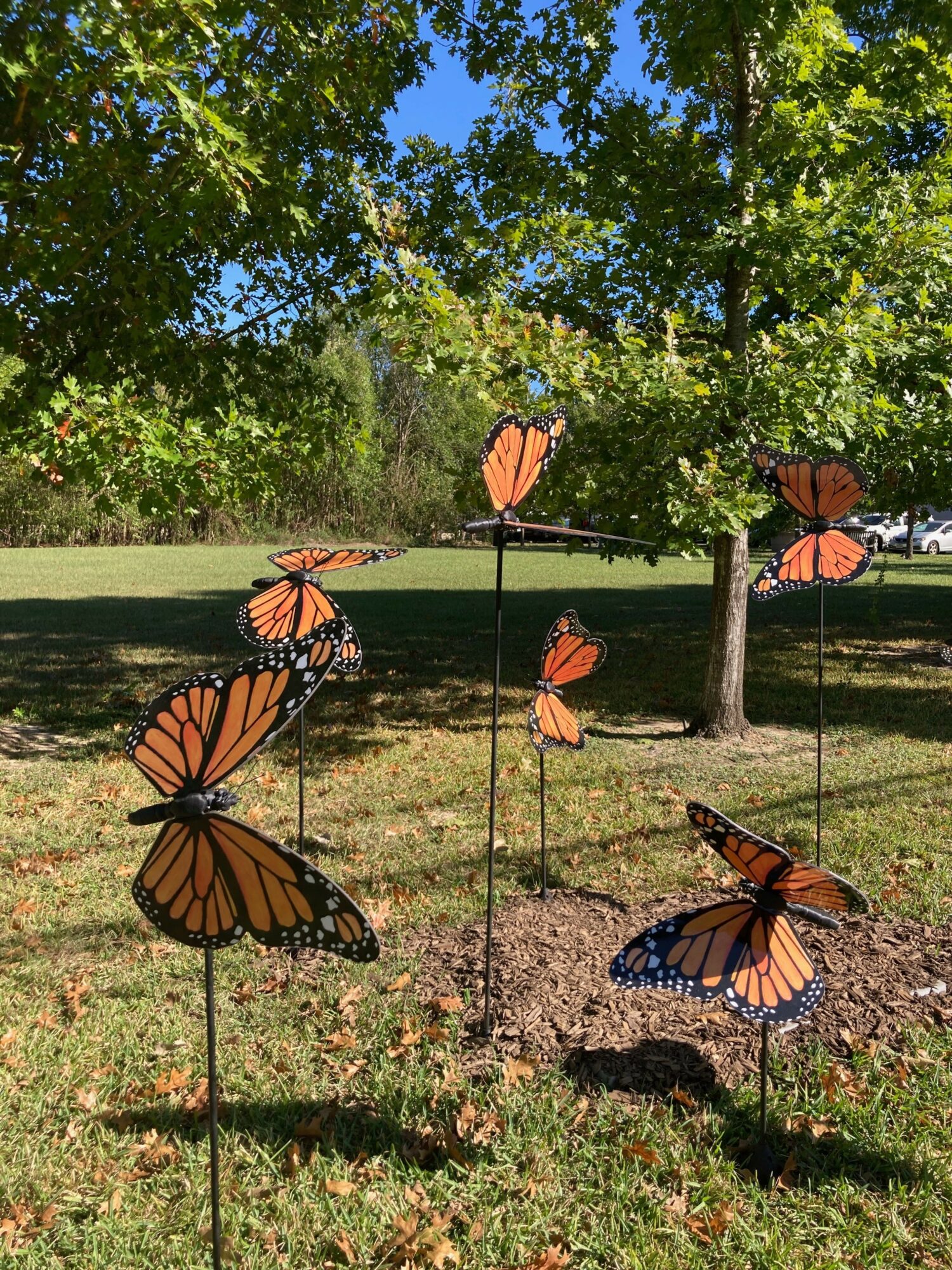
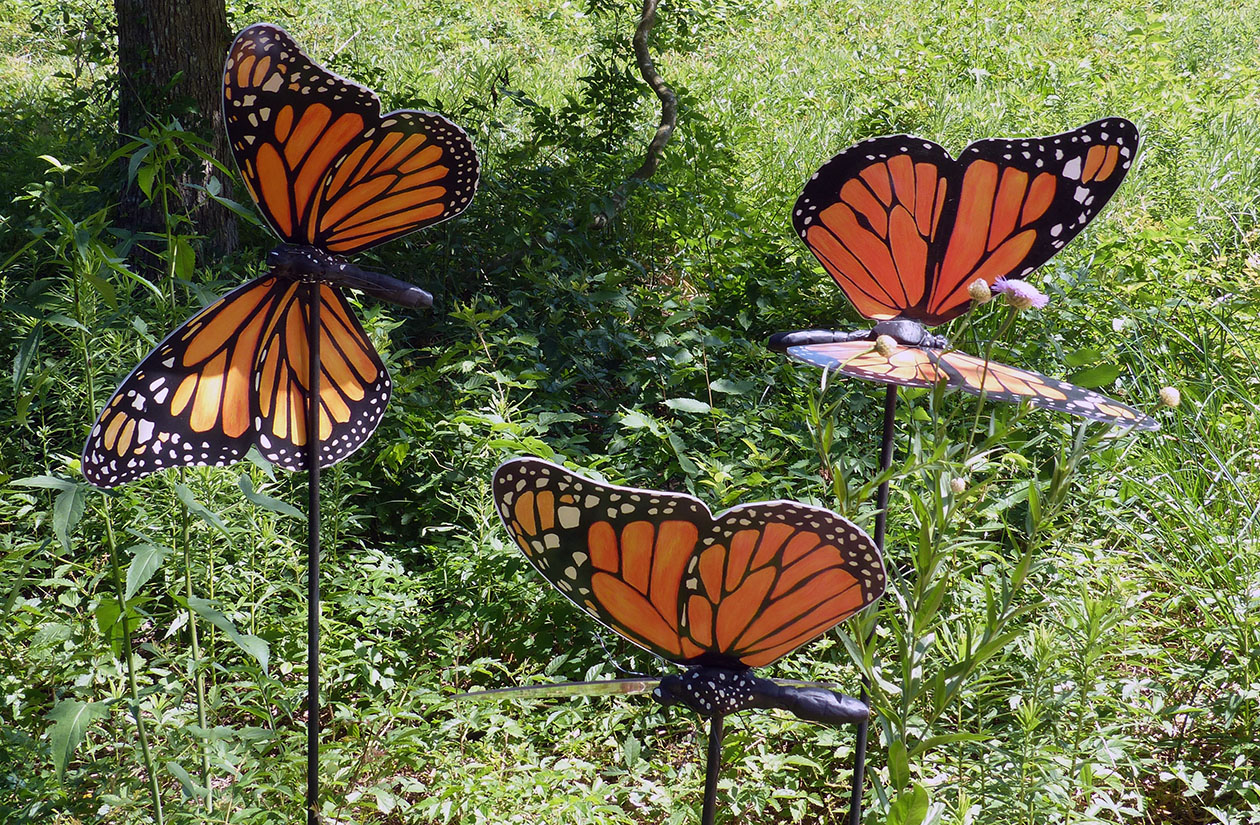
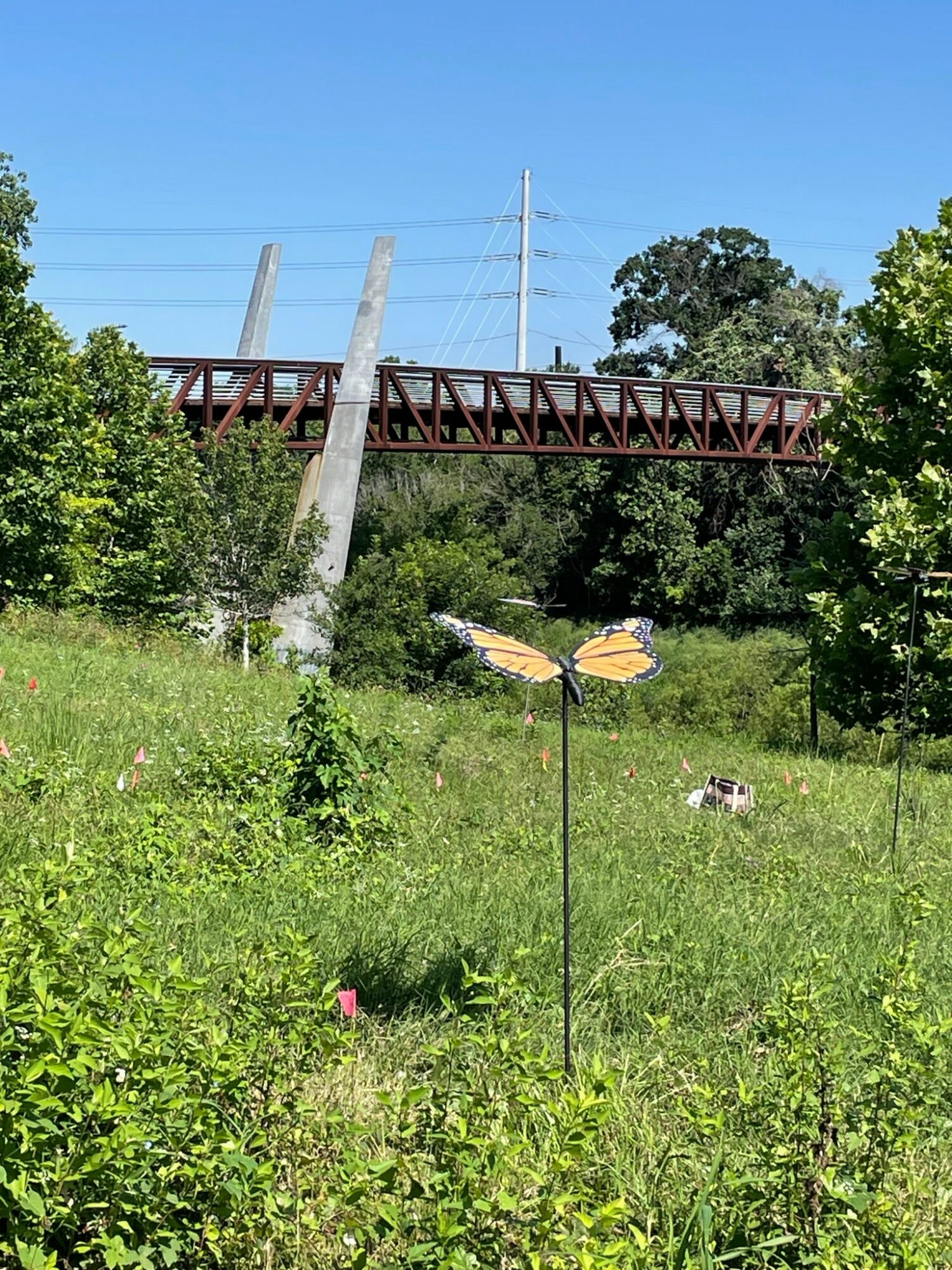
The Houston Monarch Story (HMS) began with an uncomfortable realization: I was aiding the demise of monarch butterflies by planting only Tropical Milkweed, which carries a parasite called OE that alters the Monarch’s physical structure. I’d been trying to help, and instead I was part of the problem. That discomfort became the spark — I wanted to turn what I’d learned into something others could act on, not just feel guilty about. The response was a collaboration of nature, information, and art. I worked with a team to develop larger-than-life monarch butterfly sculptures that flutter above a garden of Texas native pollinator plants, paired with printed signs and QR codes that link to deeper information on these sensitive creatures and how to protect their habitat.
What emerged was an interactive education piece at the intersection of art and technology: sculptures that draw people into a pollinator garden, and QR codes that open onto the University of Houston Coastal Center’s resources on migration, life cycle, host plants, and community Q&A — all in English and Spanish. People needed a way into the science that didn’t feel like homework. The sculptures are the invitation; the information is what stays with them.
Alright, so let’s dig a little deeper into the story – has it been an easy path overall and if not, what were the challenges you’ve had to overcome?
It wasn’t smooth. I had to become fluent in Monarch biology, QR code logistics, and outdoor-durable public art fabrication — all while lining up funding and a site — almost simultaneously, none of which were my background. This is the kicker: I didn’t know how to use color or draw a butterfly wing. Thank you, YouTube and a bunch of supportive friends who gently coached me! But first I needed a well-thought-out concept, a potential site, a website, a budget, and a timeline. Yes, it was overwhelming, and that was the beginning. After I received a Support for Artists and Creative Individuals Grant from the Houston Arts Alliance at the end of 2023, Buffalo Bayou Park agreed to highlight HMS in its annual summer species series. Texas Master Naturalist, Gulf Coast Chapter, agreed to donate and plant over 600 native plants grown from seed, some dug from the UH Coastal Prairies or rescued from TXDOT sites; all needed to be planted by mid-February for the May 18, 2024 opening.
Before this, I received a crash course in all things monarchs from Evelyn Merz and Christine Anastas, my prairie and monarch experts. As a team, we created website content that interests all ages. For existing scientific content, we had to secure copyright permissions; for everything else, we created original signage that HMS now owns outright. On the physical signs, the character limits required text edits; the truncated text had to be accurate.
Simultaneously, I was researching the nuances of public art. Fate led me to Niell Gorman, then the industrial designer at the ION Prototyping Lab. Niell translated my vision into a 3D-printed monarch butterfly with delicate wings that gently swayed on a 3- to 6-foot steel pole. Sounds easy; it wasn’t, but we had fun and are on our 4th collaboration.
HMS and I are honored to be part of the pollinator lands of Buffalo Bayou Park, the Houston Arboretum, and Wiess Park/Redbud Art Center’s Art in the Park Series — with a Houston Zoo installation coming soon.
Can you tell our readers more about what you do and what you think sets you apart from others?
What’s next keeps me up at night in the best way: a cluster of monarchs that transports the viewer to the species’ overwintering grounds in the oyamel fir forests of central Mexico, where millions of butterflies cling to the branches all winter, then open their wings together to catch the first warmth of the sun, to display their brilliant orange wings. If I can get people to feel that image — the scale of it, the fragility of it — before they ever see it in person, I’ll have done my job.
Is there anyone you’d like to thank or give credit to?
Many people and institutions deserve credit. The UH Sculpture Faculty gave me the foundation and critical eye to develop as an artist. The Glassell School of Art BLOCK Program pushed me to think beyond the studio and into public-facing work. The UH Coastal Center was an essential partner for HMS itself, grounding the project in real science and giving it a home. The Cynthia Woods Mitchell Center for the Arts and the Houston Arts Alliance offered the kind of institutional support and advocacy that makes projects like this possible in the first place.
Beyond these institutions, it should be noted that the Houston art community is incredibly generous with time and energy. I am grateful to so many. We support each other, listen to each other’s sometimes crazy ideas, and are there when we fall and there to celebrate our successes. The Houston Monarch Story is an example of trust — people took a gamble on me, a newbie to the nuances of public art, and with the support of many, “I” became “we.” We pulled it off. Thank you all!
Contact Info:
- Website: https://www.uh.edu/energy/coastal-center/outreach/monarch-story/ https://www.michellematthewsceramics.com/
- Instagram: @michellematthewssculptures @HoustonMonarchStory